concept declarative security in category system administration

This is an excerpt from Manning's book SOA Security.
This chapter introduces the concept of declarative security in SOA and shows how you can address these three challenges using security policies in web services. By the end of this chapter, you will understand how to codify and share security policies using standards such as WS-Policy, WS-SecurityPolicy, WS-PolicyAttachment, and WS-MetadataExchange. As some of these standards are not easy to understand, we use examples as the primary mechanism to describe the ideas behind them. You will also learn the shortcomings of these standards and be able to plan for necessary extensions in your use.
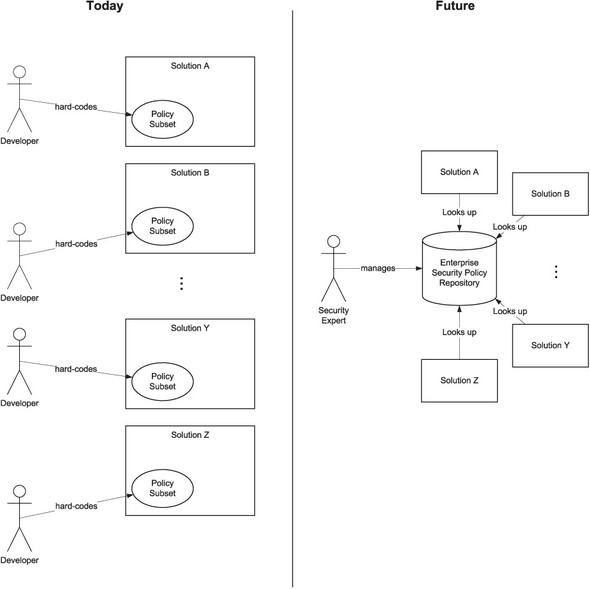
Most web services platforms already support separation of concerns between security experts and service developers. In fact, the latest versions of all leading web services platforms take a policy-driven approach to security, making declarative security not only possible but also the easiest and the most natural way to secure services. If you are developing a service today, you can configure it to be secured by a security policy that was created independently. The security policy may be created by security experts in your enterprises, or you may pick one of the prepackaged security policies provided by your platform vendor. In either case, you are taking a declarative approach to security.