concept documentation in category system administration

This is an excerpt from Manning's book Operations Anti-Patterns DevOps Solutions.
With those definitions laid out, it should be noted that continuous deployment can’t really happen without continuous delivery. Continuous delivery is a stop on the journey to continuous deployment. Despite the hype around continuous deployment, I personally don’t feel it’s a great goal for all companies. The act of continuous deployment is supposed to force certain behaviors onto the organization. You need rock solid automated testing if you’re going to deploy every commit to production. You need a solid code review process to ensure multiple sets of eyes have looked at code from whatever review criteria your teams have setup. Continuous deployment forces this behavior because without it, disaster might ensue. I believe in all these things. But I also believe that many teams and organizations have a lot of hurdles to overcome before they can realistically begin talking about continuous deployment. When tech teams take weeks to roll out patches for their systems, moving to continuous deployment seems like a pretty big leap. I think the act of continuous delivery is a better goal for most organizations. The goal of deploying every change as it gets committed is a noble one. But so many organizations are so far away from being able to safely and reliably do that. Many of their internal processes are structured around the idea of a deliverable unit called a “release”. But when you’re doing continuous deployment, even the concept of what a release is has to change within the company. How many internal processes are based on software versions? Sprints, project plans, help documentation, training, all these things are often centered around this ritualistic concept of a release. Considering how far the journey is, I think targeting the ability to release more frequently will give tremendous benefits without having to create upheaval within the organization regarding how they view, manage and market their software platform.
I want to be specific about how I use the term “valued”. Everyone thinks they value documentation, but it’s not really true. People think documentation is important, but that’s very different than actually valuing it. People think toilet paper is important, but it’s not until it becomes a scarcity that people actually begin to value toilet paper. (I write this during the 2020 COVID-19 pandemic, where toilet paper and paper towels have suddenly become the most in demand product in every grocery and household goods store in the country)
Another example of how company’s value some documentation and not others. Have you ever launched a service, application or product without any documentation around it? Most of you probably have. In organization’s like that, documentation might be important. They wouldn’t stop you from providing documentation on the product and would probably even applaud you. But when push comes to shove, if you need to launch that product, a lack of documentation is definitely not going to push the go-live back any time. Now on the other hand, try submitting an expense report without documentation for every single reported transaction and see how far that submission gets. Probably not very far at all. You might argue that with expenses, the company is at risk of being defrauded, overpayment for non-existent expense and other types of financial malfeasance. But I argue that there’s just as much risk of doing that with applications, technical products and code changes.
The value of documentation is rooted in action, not rhetoric. And your systems have to be in place to treat documentation as something that’s valued in the organization. If you’re willing to skip on documentation, then ask if it’s really something that’s valued. And if it’s not, then that’s OK. It can be hard to break a company of poor documentation habits if it’s not something that the organization values.
When dealing with the unhappy path of the billing process you suddenly realize how intertwined these steps are and just how much one effects the other. Finding a bit of information on the preceding processes might help an engineer looking into the billing job execution understand with more precision and clarity exactly how his tasks interact with other tasks. Maybe the engineer was completely unaware of how credits get applied and in which circumstances? A little bit of documentation can go a long way in helping with that. Having the documentation referenced, even in passing, in a master document for the billing process makes it much easier for someone to find information they didn’t even realize they were missing. As an engineer, if I’m unaware of the credits granting process, how would I ever think to look for it in documentation? This is the strength of having a master document on a process that points the reader into the different areas that have more specific information.
The master document should focus on a process, application or system and provide a jumping off point for any specific departmental information if necessary. Documentation should form a hierarchical structure, leading back to the master document that it covers, and that master document should be concise and specific about a topic. Having all of your documents connect up to a department or team master document is ineffective because then others don’t contribute to it with the understanding that the team owns that document. But when the organization has a single document called “Billing” and everything regarding billing links up to it, then there’s a much stronger sense of communal ownership of it.
Figure 10.4 How the hierarchy of documentation can exist for the billing example
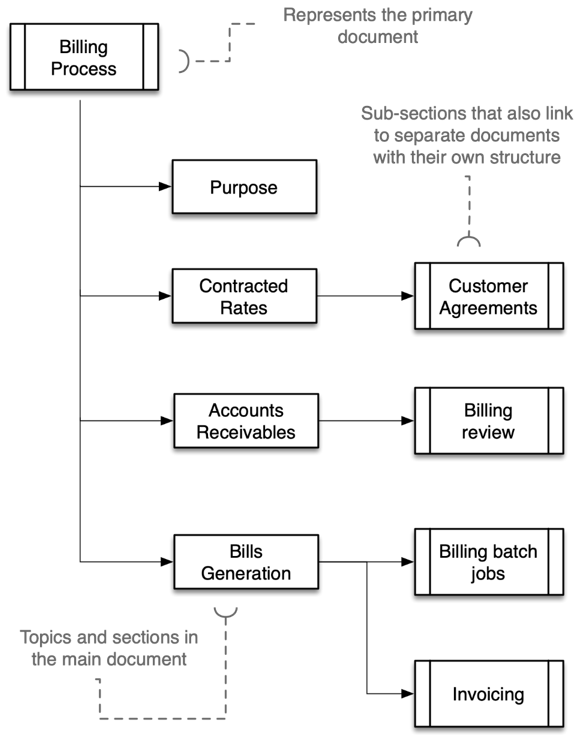
Another advantage to the master document approach is that there are more eyes on it. One of the reasons documents get outdated is because fewer eyeballs see the inconsistency and take action to correct them. When it comes to documentation you have to consider the Pareto principle, also known as the 80/20 rule. The rule states that 80% that for most events, 80% of the effects are come from 20% of the causes. Meaning if you have ten people working on a wiki document, 80% of the work on that document is going to come from two people.

This is an excerpt from Manning's book SOA Governance in Action.
“All the services that are provided to external clients must have documentation explaining all the service operations. This documentation must explain what the operation does, must explain all the arguments the operation takes, and must describe the results of the operation. Furthermore, if there’s a logical sequence in which operations need to be called, this flow should be described as well.”
If you want to create services that can be easily used by your consumers, you need to provide good documentation and versioning strategies. If you don’t have these in place, you’ll either not get anybody to use your service or, with the first upgrade, scare your existing consumers away with breaking changes. When you keep good documentation, versioning, and reuse in mind during the development phase of your service, you make it a lot easier on your consumers; they have a clear set of documentation on how your service should be used and also know the consequences of a version change.
In this section we’ll look the various parts of a WSDL and how you can document these parts. Before diving into the details, a quick sidestep on how to add documentation to a WSDL is in order. If you look at the XML of a WSDL file you’ll see lots of different elements: definitions, types, bindings, ports, services, messages, and so on. These are all elements in the http://schemas.xmlsoap.org/wsdl/namespace. For all these elements you can add documentation like this:
<wsdl:documentation>
  ..
</wsdl:documentation>
Anything entered between the wsdl:documentation tag is treated as documentation. The only restriction is that the content needs to be valid XML. Besides elements from this namespace, in a WSDL you’ll also find type definitions, either using an inline schema or included from an external XSD file. If you have complex types in your schemas, it’s good practice to document these. For schemas this is done like this: