concept extension point in category system administration

This is an excerpt from Manning's book Tuscany SCA in Action.
The SCA 1.0 specifications define standard implementation types for Java code and code written in BPEL, C++, C, and COBOL, as well as Spring, web applications (.war files), EJBs, and Java EE archives (.ear files). SCA also provides an extension point for creating additional implementation types.
Tuscany meets the extensibility challenge by defining a consistent and simple model for adding extensions through its extension point mechanism. An extension point is a bridge between the core and extensions that are not known to the core upfront. It functions as a container for a given extension type and collects all the extensions of that type that plugs into the Tuscany runtime. An extension point usually comes with a Java interface or base class to define the behavior of the extensions.
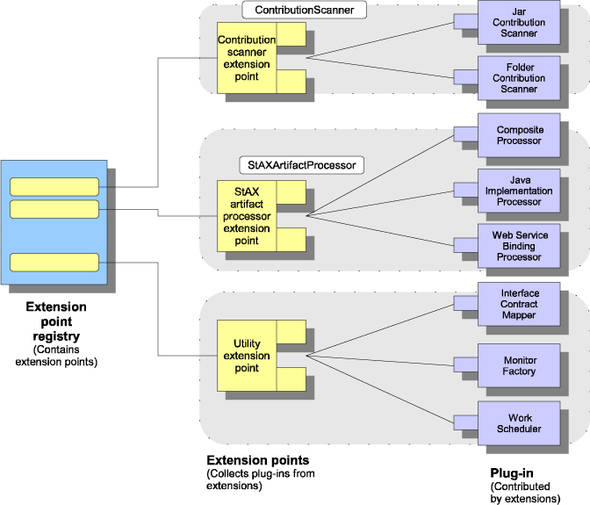
The extension point registry will be used to find information about extension points and find extension plug-in code. The following piece of code shows how the registry lookup works.
ModelFactoryExtensionPoint factories =
    registry.getExtensionPoint(ModelFactoryExtensionPoint.class);

assemblyFactory = new RuntimeAssemblyFactory();
factories.addFactory(assemblyFactory);

MessageFactory messageFactory =
    factories.getFactory(MessageFactory.class);
First, the extension point is looked up in the registry using the extension point’s interface, in this case ModelFactoryExtensionPoint. Then a new plug-in is added into this factory extension point. The plug-in here is RuntimeAssemblyFactory. Finally the extension point is used to look up a factory plug-in based on the type of thing that the factory can create, in this case MessageFactory-based classes.
In Tuscany, extension points and plug-in code are modeled using Java interfaces or abstract classes. To allow extension points and plug-in code to be declarative and pluggable, Tuscany adopts the service provider pattern defined by the JAR file specification.