concept goal in category system administration

This is an excerpt from Manning's book Operations Anti-Patterns DevOps Solutions.
Fast forward to 2008, a developer by the name of Andrew Shafer attends the Agile Conference in Toronto. At the conference, he proposes an ad-hoc discussion session called “Agile Infrastructure.” Andrew received such poor feedback on his proposal, that he didn’t even attend the session himself. In fact, only a single attendee joined the session, Patrick Debois. But because Patrick was so passionate about discussing this topic, he tracked Andrew down in the hallway of the conference where they had an extensive discussion about their ideas and goals. Directly out of those conversations, they form a group called the Agile Systems Administrator Group.
12.1 Tiers of goals
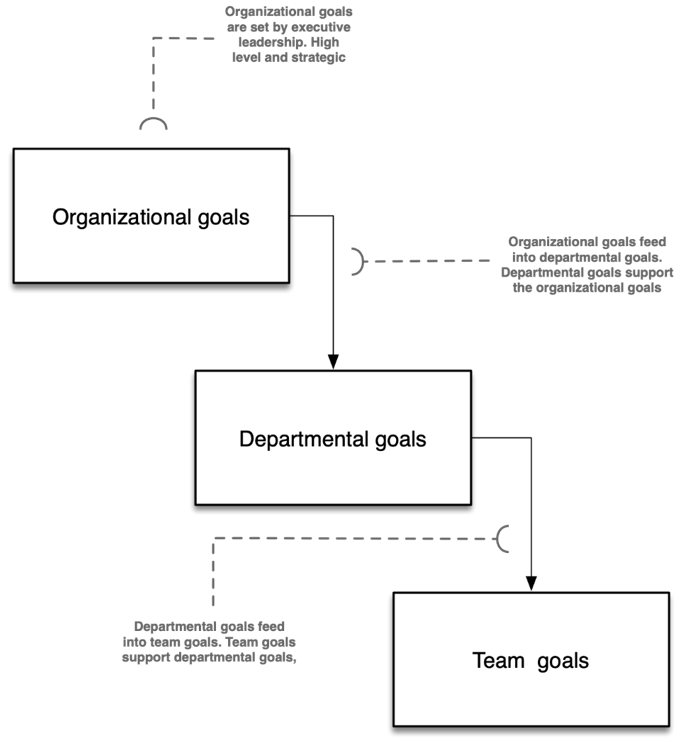
Goals are typically tiered, with one set of goals flowing into the next tier of goals. The organization has a set of goals for the year, whether it be revenue growth, the launch of a new product, or retaining customers. Whatever it is, knowing the organizational goals is necessary to create the next level of priorities, which are departmental. Each department needs a set of goals that support the organization’s goals. This gets repeated right down to the individual, whose goals are influenced by their department’s goals, which in turn is influence by the organization’s goals. This relationship is depicted in figure 12.1, noting the cascading nature of goals.
Figure 12.1 Goals cascade from the top of the organization.
Knowing your goals and how they factor into the larger set of organizational goals is, for many people, an influencer of job satisfaction. When your work is off on an island and nobody appreciates what you do or why you do it, you can become disconnected from the rest of the organization. As everyone marches on toward goals that get talked about in company-wide meetings, you’re on the sidelines wondering why you’re doing what you’re doing and if it matters at all. Understanding the organization’s goals and tying your work to one of those can go a long way to helping fight that feeling.
Team goals usually map to more tactical versions of departmental goals, where the team goals are much more strategic in nature. “Improve billing performance” is a strategic goal set at the department level but doesn’t lay out anything resembling a plan for how to achieve that. Team goals help to provide the high-level strokes of how the department is going to execute on improving billing performance. The goal might not be a single team effort either. The goals might spread across multiple teams. Development teams might focus on different parts of the code that are known to be particularly slow, while operations teams might focus on tuning the existing hardware to squeeze out more performance. In table 12.2, I’ve given a few examples of how different team goals map to departmental, and organizational goals.