concept header in category system administration

This is an excerpt from Manning's book SOA Security.
As you can see, XSD specifies the syntactic structure of an XML document only. For example, the preceding specification does not tell us what goes in the body and what goes in the header. It is good enough for several purposes—notably for specifying abstract types in WSDL, which we will be using later for describing web services.
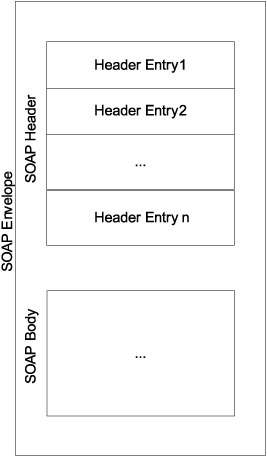
Figure 3.3 depicts the location and composition of the Header element in a SOAP envelope. The header, if present, should be the first immediate child element of the SOAP envelope. All immediate child elements of the Header element are called header entries. (It is common to refer to a header entry as header in contexts where it is clear that the term refers to a header entry and not to the entirety of a SOAP message header.) A header entry is identified by its fully qualified element name, which consists of the namespace URI and the local name. All header entries must be namespace-qualified.
Figure 3.3. Place of header and header entries in a SOAP envelope. Within the SOAP envelope, any number of headers can be introduced prior to the body element. Any organization can make up its own header, keeping the SOAP message syntactically valid. Most useful headers are ones where there is wide industry support and tool support.
SOAP allows for extensions in the form of headers. SOAP does not specify any headers by itself; instead, it provides a framework for incorporating and processing arbitrary headers. It specifies where headers can appear in a message, how they can be encoded, and what every SOAP engine or SOAP-based web service must adhere to when processing headers. The actual content of headers is governed by mutual consent of service providers and service consumers. For example, in an organization, the IT department can mandate certain header entries for the purpose of IT governance.
This situation can be chaotic, with each company defining its own SOAP extensions using custom headers. However, SOAP extensions for addressing common problems such as security are standardized by groups like OASIS. One such standard extension, WS-Security, defines a header related to security, and obviously, is of particular interest to us. In this book, we show how this standard extension can be used to develop security solutions for SOAP-based web services.
In this section, let us see what kind of support SOAP offers for headers. We will also introduce WS-Security.