concept input in category system administration

This is an excerpt from Manning's book Securing DevOps.
You may recall from chapter 2 that the invoicer exposes several endpoints to manage invoices, one of which creates new invoices based on JSON data submitted in the body of the POST request. Consider the JSON document in the following listing as the input of an attack and pay particular attention to the description field. Instead of containing a regular string, inject HTML code that calls the JavaScript
alert()function.
Listing 8.1 Hindsight: run with local directories mounted inside the container
$ git clone https://github.com/Securing-DevOps/logging-pipeline.git

$ tree -L 1 logging-pipeline/
   logging-pipeline/
├── cfg    #1
├── logs    #2
└── run    #3

$ cd logging-pipeline
$ chmod 777 output run    #4
$ docker pull mozilla/Hindsight    #5

$ docker run -it \
 -v $(pwd)/cfg:/app/cfg \    #6
 -v $(pwd)/logs:/app/logs \    #6
 -v $(pwd)/run:/app/run \    #6
 -v $(pwd)/output:/app/output \    #6
    mozilla/hindsight

#1   Hindsight configuration folder
#2   Log data fed as input to Hindsight
#3   Runtime input, analysis, and output plugins
#4   Allows Hindsight to write to the output and run directories
#5   Retrieves the container from Docker Hub
#6   Mounts the local directories inside the container when running it, replacing the default configuration and plugins of the container with the local ones
Fuzzing is the process of injecting invalid and malformed input into the interfaces of a program in an attempt to trigger a vulnerability in the handling of said input. In the previous example, an email address containing an invalid Unicode character is a perfect example of malformed input that a fuzzer could’ve injected into the Persona application. It’s not, however, nearly as easy as it sounds, and fuzzing applications requires a lot of effort and often the full commitment of an engineer to yield valuable results.
These two methods can also be combined, for example, by generating an input from a grammar and mutating it to explore the boundaries of an application. Fuzzers can work on a local application, typically by targeting the binary of an application or by sending traffic through the network, as in the case of a web application.
American fuzzy lop (AFL; http://lcamtuf.coredump.cx/afl/) and Radamsa (https://github.com/aoh/radamsa) are examples of file-based fuzzers that generate mutations to stress the input of an application. Radamsa is a black-box fuzzer, and AFL is a white-box fuzzer. AFL uses a technique called instrumentation to learn about the internals of a program and test its security more effectively. Instrumenting an application requires compiling it in a specific way, which is why AFL is called a white-box fuzzer.
Burp Intruder (part of the Burp Suite) and ZAP both provide network-based fuzzers that can target the input of web applications. These tools take a template of the traffic the application accepts, typically by spidering it, and then mutate inputs using random generators or grammars.
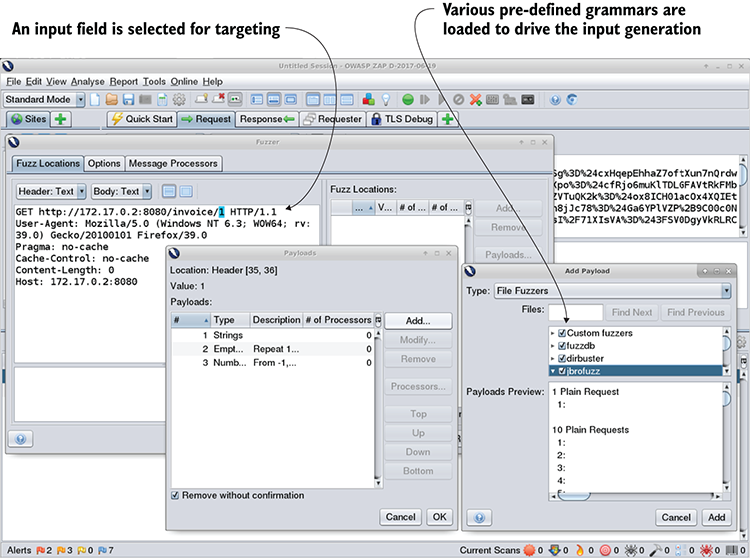
Figure 12.6 shows how ZAP can be used to fuzz the input of the invoicer application. The tool can target a resource discovered during spidering, select a specific component of the HTTP request (here, the invoice ID), and inject randomized input in a variety of formats.
Figure 12.6 ZAP supports fuzzing web application using grammars and generated input.

This is an excerpt from Manning's book SharePoint 2010 Site Owner's Manual: Flexible Collaboration without Programming.
Track which feedback forms have been sent out for input.