concept instance in category system administration

This is an excerpt from Manning's book Learn Active Directory Management in a Month of Lunches.
All domains in a forest share a common Configuration container (for instance, they contain information on AD sites like services such as Exchange and AD partitions) and a common schema. The domains are linked together by transitive trusts that are automatically created when the domains are created.
2. One or more policy servers that issue certificates to your issuing servers and define the rules—for instance, the types of certificate that can be issued and who can approve certificates.
An account partner is the external organization that hosts and manages the user accounts. AD or ADLS accounts can be used to provide access to the application. The federation server in the account partner organization issues security tokens that make assertions about the users—for instance, the user can perform certain actions. The tokens are presented across the federation trust to the resource partner.

This is an excerpt from Manning's book SOA Governance in Action.
This step is mostly an organizational step where you get all the stakeholders together (for instance, in a SOA governance board) and, based on the strategy and goals of the company, coordinate and control the various SOA efforts. The organizational part of SOA, which is the subject here, is an important part of SOA governance. If there’s no backing from your stakeholders, it’s hard to apply SOA governance effectively and define the correct policies to implement and enforce. This means that besides the technical aspect of applying the policies you define, you also need to take into account the roles the process and the people play in regard to SOA governance. These concepts are sometimes called the three Ps: people, processes, and policies.
Before we look at the set of products OpenGov offers, let’s look at an organizational chart so you can get a good overview of the various departments within this company. This is interesting because each department has its own specific goals and requirements. For instance, the Legal department follows all new legislation. Based on new laws, it may define new policies that have to be applied to various products and services OpenGov provides. The organizational chart is shown in figure 3.1.

This is an excerpt from Manning's book Azure in Action.
Moving instances of your role in fault situations
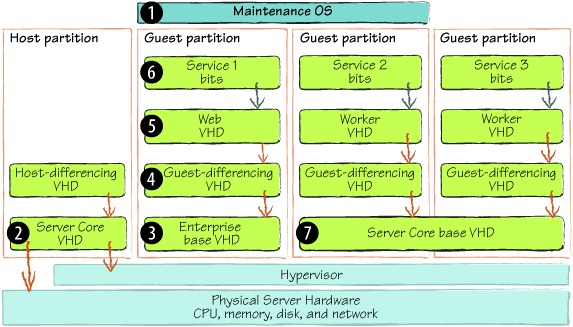
Figure 3.11. The structure of a physical server and virtual instance servers in Azure. This figure illustrates the process involved in starting the server (
and
). It also shows the process of starting an instance and adding it to your service (
through
), and adding another virtual server (
). All these steps are coordinated by the FC and take only a few minutes.
The number of instances of your role
We’re now going to briefly look at the most important piece of configuration in Windows Azure: the number of instances that your role has. The following XML defines five instances of your role:
<Role name="ServiceRuntimeWebsite">
    <Instances count="5"/>
</Role>
If you need to increase the number of instances required for your web role, you can modify this value in your service configuration file. During development, you can also modify this value using the Configuration tab in the Visual Studio GUI.

This is an excerpt from Manning's book Open Source SOA.
Other factors also served to dampen the interest in SOAP web services. The perceived complexity of the various WS-* standards led to a movement to simply use XML-over-HTTP, as is the basis for Representational State Transfer (REST)-based web services (for more on this raging controversy between REST and SOAP, see [RESTvsSOAP]). The nomenclature found in the WSDL specification, such as port types and bindings, is alien to many developers and strikes them as overly convoluted, especially for simple services (in the WSDL 2.0 standard, some of this arcane nomenclature has been removed, for instance, replacing port type with interface and port with endpoint, which is a big improvement, especially for Java and C# developers who are already familiar with such terms and their meaning). Interestingly enough, some convergence between REST and SOAP is taking place, such as the acknowledgment among some REST advocates that the metadata description capabilities of a WSDL are important. Towards this end, REST advocates have devised a new metadata specification for REST-based web services called the Web Application Description Language (WADL) [WADL]. While I may sometimes appear to be a bigot of SOAP, that’s primarily because of the metadata features of WSDL, and REST coupled with WADL creates a compelling alternative.
Perhaps more importantly, you can also associate timers with the superstate (this does require the Enterprise edition of jBPM—in other words, the app server edition). In the scenario shown in figure 7.1, you could, for instance, notify a manager of the HR department that their team’s work hasn’t been completed in a timely fashion. Thus, when using events and timers in tandem with superstates, there’s a benefit beyond the obvious achieved by providing visual hierarchy and grouping. Related in concept to superstates are subprocesses, which are intended to provide greater process composition flexibility.
Once you have an instance of the LoggingInstance class (shown here as logging-Instance), you can use it to retrieve the set of logs associated with that process instance. The number and type of logs that appear will vary based on where the execution cycle is in the process instance(s), as well as the type of nodes being used. The following is an example of how you can retrieve all of the available logs via the loggingInstance we acquired earlier:

This is an excerpt from Manning's book SOA Security.
As a CEO, you want to innovate and raise the top line of your firm. You can do several things. For instance, you can increase sales by understanding customer needs better and creating self-service channels that induce customers to buy more of your products. You can work with your partners better and make it easier for them to sell your products as part of their offerings. Or, you can make your offerings more compelling by bundling them with offerings from your partners. You can also reach out to new customers through targeted campaigns and venues.
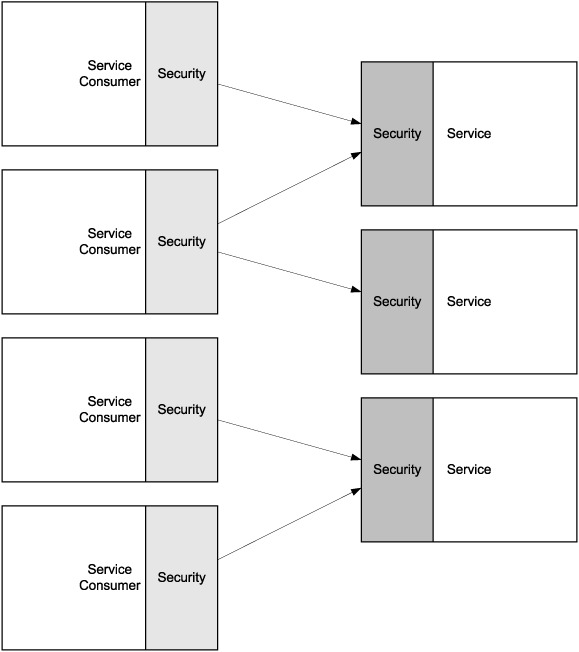
Figure 8.1. Security implemented as part of each service and service consumer. Each service implements its own security, which is invoked as a part of service consumer and provider. For instance, the consumer may add username and password information and the provider may validate them and grant access.
Assertions about the supporting tokens we need in addition to the tokens required by each security usage pattern supported by the endpoint. For instance, we may specify that a SAML assertion is needed.