concept integrity in category system administration

This is an excerpt from Manning's book Securing DevOps.
System auditing —Auditing the integrity of live systems is an excellent way to keep track of what’s happening across the infrastructure. On Linux, the audit subsystem of the kernel can log system calls performed on a system. Attackers often trip on this type of logging when breaching systems, and sending audit events into the logging pipeline can help detect intrusions.
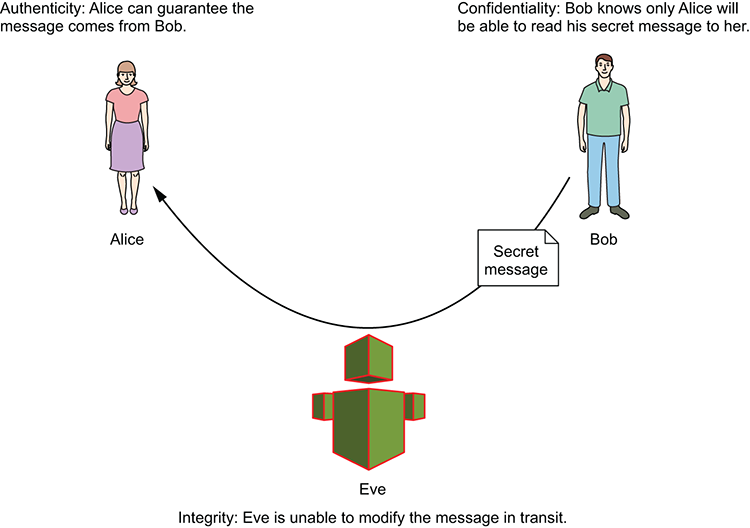
Figure 5.1 Confidentiality, authenticity, and integrity are the core security properties that allow Alice and Bob to communicate safely and prevent Eve from interfering.
Integrity is a tricky concept to define. Unlike confidentiality, people only learn the meaning of integrity much later in life (and some people never learn it at all) and thus have trouble applying it to computer systems. In fact, I find that discussing integrity risks is often the most challenging part of a risk assessment.
In people, integrity measures the honesty and morality of a person. The degree of integrity required of someone depends on their role in society: a low-ranking soldier turning into a spy would probably have fewer consequences than, say, a general would. The need for integrity increases as a person’s responsibility increases, because a loss of integrity would have a greater impact.

This is an excerpt from Manning's book SOA Security.
When an application receives a message, it needs to make sure that the message received is exactly what the sender sent and not something that is fabricated/tampered with by a man in the middle. In other words, applications are responsible for verifying integrity of data received over a network. Furthermore, the sender should not be able to “repudiate” or deny having sent a message.
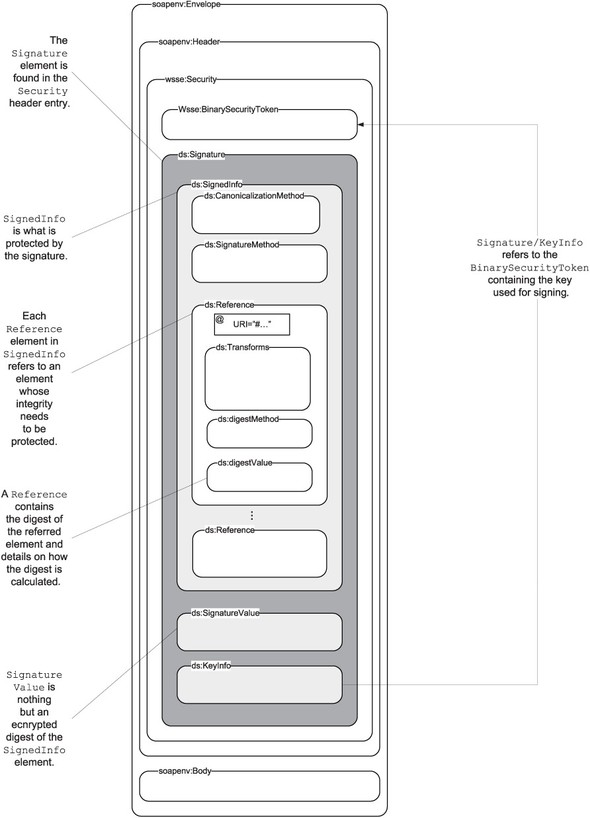
In the previous chapter, we learned how to apply encryption to safeguard the confidentiality of messages. When studying the basics of encryption and PKI, we also briefly looked at digital signatures and how they aid in the detection of message tampering. In this chapter, we will study signatures in detail, particularly to verify the integrity of SOAP messages received over an unsafe network.