concept interoperability in category system administration

This is an excerpt from Manning's book Self-Sovereign Identity.

Some types of divergence are irrelevant; others are fundamental. Separating the two is an important topic among identity architects, because it affects interoperability. A first attempt to describe all key choices in SSI stacks was made at the Internet Identity Workshop (IIW) in October 2018.[147] Conference participants listed eleven layers of technology that are likely to appear in SSI solutions, and described the dependencies between them.

This is an excerpt from Manning's book SOA Security.
As described in section 1.1.1, one of the basic tenets of SOA is that technology differences must not matter. A service should be usable by any service consumer, regardless of what technology platforms the service and service consumer run on. In other words, interoperability of services and service consumers is a major promise of SOA. Security approaches we adopt for SOA must not break that promise. If everyone adopts a different approach for securing services and service consumers, interoperability will certainly break. But even with standardized approaches, interoperability is not guaranteed because, for good reasons, standards have to leave some choices to implementers. For example, the choices of authentication mechanism and cryptographic algorithm have to be left to the implementers, otherwise the standards run the danger of not being applicable in all situations.
Interoperability of security solutions Security solutions in an enterprise will have to interoperate with the security solutions of the enterprise’s customers, suppliers, and partners. Interoperability is not guaranteed even if all the security solutions are 100% standards-compliant. This is because standards allow administrators to make a lot of choices—a security solution in an enterprise may demand 512-bit encryption keys whereas a partner’s security solution may only be able to work with 128-bit encryption keys. Obviously interoperability is a concern.
Figure 9.3. Use of security policies at runtime to achieve interoperability between any two parties.
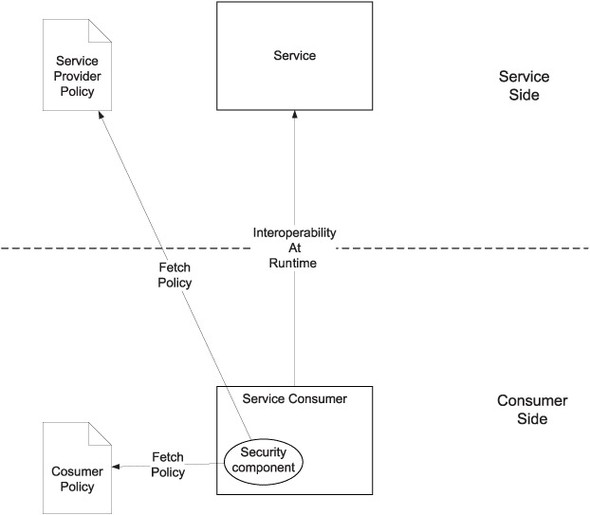
As figure 9.3 shows, the policies of parties involved in the message exchange can be fetched and reconciled at runtime to ensure interoperability. While the sophistication required for this in practice is quite high, the benefits of interoperability are attractive enough to justify the effort.