concept issue in category system administration

This is an excerpt from Manning's book Operations Anti-Patterns DevOps Solutions.
If that install breaks the server or is somehow incompatible, who is responsible for resolving the issue?
This chapter focuses on the aspects of on-call life for teams and how best to set them up for success. I detail what a good on-call alert looks like, managing documentation on how to resolve issues as well as day-time duties for team members who are on-call for the week. Later in the chapter I focus on tasks that are more management focused, specifically around tracking on-call load, staffing appropriately for on-call, and how best to structure compensation. Unfortunately, some of the tips here are geared toward leadership. Notice I didn’t say management. Any team member can be the voice and advocate for these practices. And if you’re reading this book, then you’re probably going to be that voice to raise some of these points. Although I prefer to focus on empowering tips that anyone can do, I feel that the on-call experience is important enough to break away from that restriction just a bit. Since not all readers may have experience with on-call, a brief introduction to the frustrations might be in order.

This is an excerpt from Manning's book Securing DevOps.
Missing security controls are detected prior to deployment, giving developers and operators an opportunity to fix the issues before putting customers at risk.
On the list of things that keep security engineers up at night, obscure vulnerabilities in software open to the internet is near the top. It’s definitely much rarer to find a buffer overflow in a network daemon today than it was in the late '90s, but the impact of these types of issues is still high, and finding them is incredibly difficult.
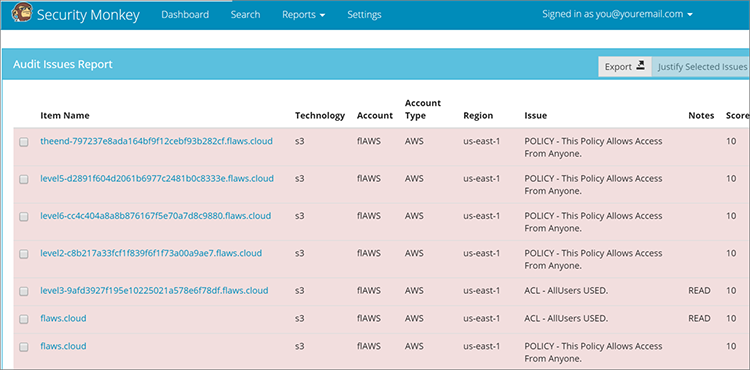
Figure 12.10 The web interface of Security Monkey shows issues found in an AWS account (http://mng.bz/kF6C).

This is an excerpt from Manning's book Team Foundation Server 2008 in Action.
This chapter takes a practitioner’s view of DB Pro. We dive into the concepts, steps, and issues involved in typical database maintenance activities. We explore the product’s main features and extensibility points. As such, the material in this chapter is introductory in nature.
The specific issues that we discuss include stamping the generated assemblies based on a consistent numbering scheme, building from specified labels instead of the tip of a codeline, setting up a service to accept code from contributors and commit to a shared repository (after validating that the code meets certain quality criteria), building source code from multiple TFS machines, and so on. As you’ll discover, some of the issues are more complex than they might appear at first glance.