concept mental model in category system administration

This is an excerpt from Manning's book Operations Anti-Patterns DevOps Solutions.
Once your team has been assembled, you’ll want to begin to have them commit to the effort of automating the process. It sounds basic but so many automation efforts fail because the team can’t create a mental model of what an automated process flow looks like. They’re rooted in these ideas of human evaluation that they can’t think of how that might be replaced by an automation algorithm and what those steps look like. As a result, the idea of automation is rejected out of hand. “It’s too complicated to automate” is a common excuse. If the world can automate a jet-liner landing, I assure you that you’re up to the task of automating your approval process. An initial discussion with the team highlighting the benefits of automating the process is inline. You can focus on things like the following:
A mental model is an explanation of someone’s thought process about how a thing works. The mental model might detail someone’s perception of the relationship and interaction between components, as well as how the behavior of one component might influence other components. A person’s mental models can often be incorrect or incomplete.
This context highlights how the OPS engineer had a flawed mental model of the system. It also highlights how the wording on the command he uses to restart the service was also at fault for extending the outage. Figure 9.2 highlights his expectations of the system versus the reality of them. You’ll notice that in the engineer’s mental model, the consumer daemon processes from the p2_queue, when in reality it has it processes from the cd_queue. Another flaw in the mental model is the engineer presumes that the generic restart command will also restart the consumer_daemon but in the actual model you can see that there is a specific consumer_daemon restart command.
Figure 9.2 The engineer’s mental model of the consumer_daemon
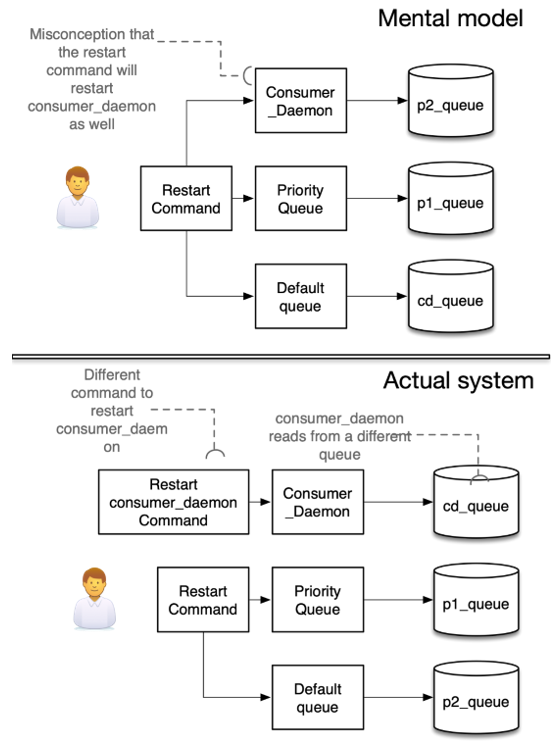
Because of the way the commands were grouped, he inferred something that wasn’t true, but had no way of knowing that his assumptions were wrong. This might lead us to an action item to fix how the restart service help documentation is worded. How you name things will inform people’s mental models. If I have a light switch and above the light switch the words “Fire Alarm” are written in bold red letters, that might change your understanding of what the light switch does. When someone asks you to “turn off all the lights”, you would most likely skip this light switch because your understanding of what it does has been altered by the label. Mental models of systems are affected much the same way. Identifying these mistakes and correcting them is a key area of focus during the post-mortem process.