The OSPF 2-Way state confirms bidirectional communication: routers have seen and acknowledged each other, but have not exchanged routing information. They are OSPF neighbors, not necessarily fully adjacent. section 18.3.1
A router reaches 2-Way after receiving a hello that includes its own router ID (RID). For example, R1 learns R2’s RID, sends it back in a hello, and R2 then moves R1 from Init to 2-Way. section 18.3.1
The state has different operational consequences depending on the OSPF network type:
- On broadcast Ethernet, DR and BDR elections occur in 2-Way. DROther routers remain 2-Way with fellow DROthers but form Full adjacencies with the DR and BDR. section 18.3.2
- On a point-to-point link, routers should form a Full adjacency without a DR or BDR; a persistent 2-Way state there may require investigation. section 18.3.2
Checking the neighbor table
Use `show ip ospf neighbor` to inspect the state. An entry such as `172.16.1.2 1 2WAY/DROTHER` shows that the neighbor is reachable and acknowledged, while the DROther role explains why it has not formed a Full adjacency with another DROther. section 18.3.1 section 18.3.2
Figure 18.9 The OSPF neighbor states: Down, Init, 2-Way, ExStart, Exchange, Loading, and Full. Routers that reach the 2-Way state are OSPF neighbors. Some routers remain in this state, and some proceed to establish a full adjacency.
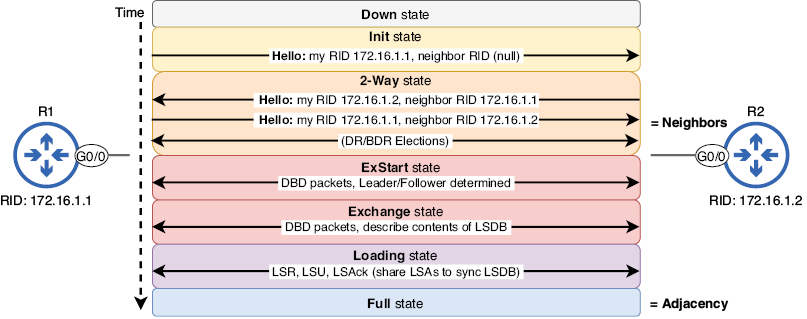
Trace the progression from Down and Init through 2-Way, ExStart, Exchange, Loading, and Full. section 18.3.1
