The 3D bin packing problem asks how to load boxes into fixed-size trailers, choosing each box’s position and orientation to use space efficiently without overlaps or out-of-bounds placements. Better packing can reduce shipments, transportation costs, and environmental impact. section 3.4
A reinforcement-learning packing environment translates the logistics task into:
- Items: rectangular boxes presented in a fixed sequence. section 3.4
- Containers: one or more trailers with fixed dimensions. section 3.4
- Actions: choose a container, position, and one of six orientations for the current box. section 3.4
- Constraints and rewards: reject collisions or out-of-bounds placements; reward successful packing and penalize invalid actions or skipped items. section 3.4
A small packing instance
A box with dimensions 4 × 3 × 2 could be placed in a trailer measuring 10 × 8 × 6. The agent must select a feasible position and orientation while accounting for already occupied space. section 3.4
Figure 3.7 Visualization of one instance of trailer loading and packing environment.
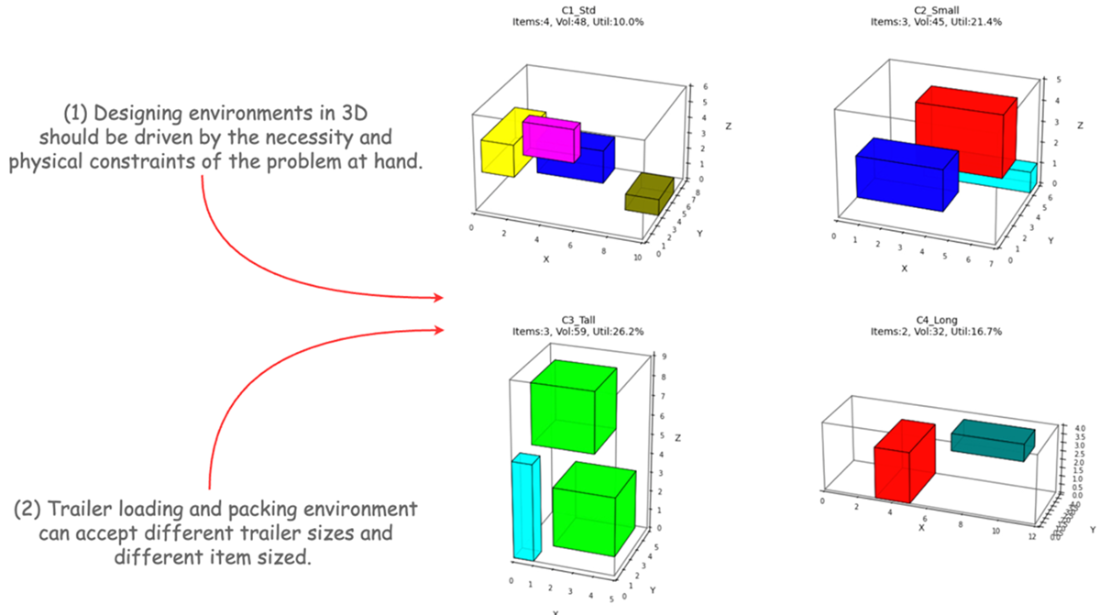
A 3D visualization helps make the container layout and item placements concrete. section 3.4
