liveBook · Manning

Absolute error

As explained in Ensemble Methods for Machine Learning

Absolute error measures prediction error as the absolute difference between a target and its prediction.

Absolute error (AE) measures a regression residual as |y − f(x)|, the absolute difference between the target and prediction. It corresponds to assuming a Laplacian distribution over residuals. section 7.3.1

Use absolute error to understand these practical tradeoffs:

  • Penalizes large errors less aggressively than squared error, making it less sensitive to outliers. section 7.3.1
  • Lacks second-order differentiability, so it cannot be used directly with Newton boosting. section 7.3.1
  • Contrasts with Huber loss, which uses squared error for small residuals and scaled absolute error beyond a threshold. section 7.3.1
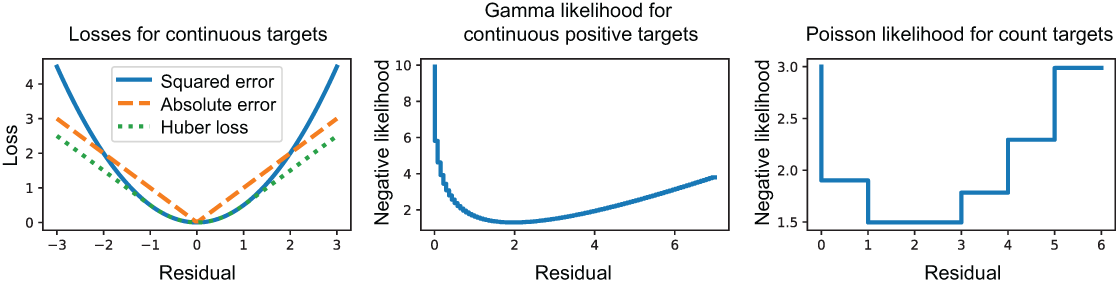
Figure 7.10 Loss and log-likelihood functions for three different types of targets: continuous-valued (left), positive continuous-valued (center), and count-valued (right)
CH07_F10_Kunapuli

Compare the absolute-error curve with squared error and other loss functions across residual sizes. section 7.3.1


How Ensemble Methods for Machine Learning covers it

How deep it goes
Defines the formula, likelihood interpretation, outlier behavior, and differentiability limit for Newton boosting.
Examples
Visualizes absolute error alongside squared error and other loss functions in Figure 7.10.
What you can do after
Evaluate regression loss choices by comparing outlier sensitivity, likelihood assumptions, and differentiability.
How it connects
Connects absolute error to squared error, Huber loss, pseudo-Huber loss, Laplacian distributions, and boosting.

Also explained in

Compare how 2 books explain absolute error →

Related concepts

This explainer was generated by Manning's knowledge graph from the text of Ensemble Methods for Machine Learning. The section links point to the parts of the book it draws on.