liveBook · Manning

Absorbing

As explained in Real-World Cryptography

Absorbing is the sponge-construction phase in which input blocks are combined with the rate portion of the state and permuted.

Absorbing is the sponge-construction phase that ingests input. Each input block is XORed with the state’s rate portion, then the complete state is permuted before the next block. section 2.5.2

The phase proceeds in a short loop:

  • Split input longer than the rate into blocks. section 2.5.2
  • XOR each block with the rate, leaving the capacity untouched during that combination. section 2.5.2
  • Permute the resulting state after every block; padding distinguishes inputs such as 0 and 00. section 2.5.2

A five-bit input

With a five-bit rate and an initially zero rate, absorbing 00101 XORs those five bits into the rate and then permutes the state. section 2.5.2

Figure 2.15 In order to absorb inputs larger than the rate size, a sponge construction iteratively XORs input blocks with the rate and permutates the result.
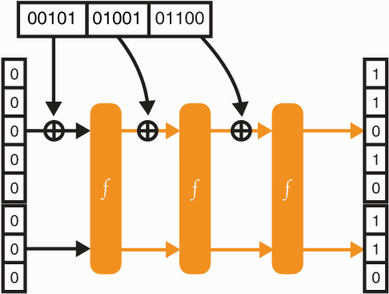
Shows how inputs larger than the rate are absorbed by repeatedly XORing blocks with the rate and permuting the result. section 2.5.2

How Real-World Cryptography covers it

How deep it goes
Defines XOR, rate-based blocking, permutation, and padding, but stops before digest extraction.
Examples
Uses a five-bit 00101 input and repeated processing of inputs larger than the rate.
What it assumes
Assumes familiarity with XOR, state, rate, capacity, and permutation while illustrating the absorption loop concretely.
What you can do after
Understand how sponge constructions ingest padded input before producing a digest.
How it connects
Connects sponge construction with rate, capacity, permutation, padding, and squeezing.

Related concepts

This explainer was generated by Manning's knowledge graph from the text of Real-World Cryptography. The section links point to the parts of the book it draws on.