liveBook · Manning

Absorption

As explained in Acing the CCNA Exam: Volume 2 Advanced Networking and Security

Absorption is the conversion of electromagnetic-wave energy into heat as a wave passes through a medium.

Absorption occurs when an electromagnetic wave passes through a medium and converts into heat, weakening the wireless signal. The resulting weakening is called attenuation. section 18.1.2 section 18.5

Account for absorption when evaluating wireless coverage:

  • Dense walls can absorb enough energy to prevent devices on the opposite side from receiving a coherent signal. section 18.1.2
  • Higher-frequency wireless signals are generally more susceptible to absorption by obstacles. section 18.2.1
  • Lower frequencies generally penetrate obstacles better and cover larger distances, although they typically provide lower transfer rates. section 18.2.1
Figure 18.4 Phenomena affecting the behavior of electromagnetic waves include absorption by a medium, reflection off surfaces, refraction (bending) as waves pass through a medium, diffraction around obstacles, and scattering from irregularities.
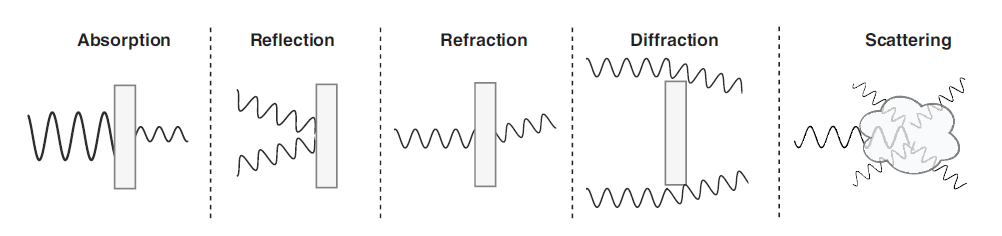
Compare absorption with reflection, refraction, diffraction, and scattering as electromagnetic waves encounter media and obstacles. section 18.1.2

How Acing the CCNA Exam: Volume 2 Advanced Networking and Security covers it

How deep it goes
Defines the conversion and attenuation mechanism, gives a wall example, and relates susceptibility to frequency without covering calculations.
Examples
Uses a wireless signal crossing a dense wall and compares higher- and lower-frequency propagation through obstacles.
What it assumes
Assumes basic awareness of wireless signals while defining attenuation and relating absorption to electromagnetic-wave behavior.
What you can do after
Evaluate wireless coverage effects by identifying absorbing obstacles and comparing frequency-dependent penetration.
How it connects
Connects absorption with attenuation, electromagnetic waves, frequency, reflection, refraction, diffraction, scattering, and wireless LAN design.

This explainer was generated by Manning's knowledge graph from the text of Acing the CCNA Exam: Volume 2 Advanced Networking and Security. The section links point to the parts of the book it draws on.