An abstract syntax tree (AST) is a tree-like representation of the relevant structure in program code after parsing. For `1 + 11`, the `+` can be the root and the two number literals its branches. This structured form helps a compiler work with code, while spans retain links to original text for diagnostics. section 3.2
In Rust procedural macros, input arrives as a `TokenStream`, but parsing can turn that input into AST types such as `DeriveInput`. The AST can then supply parts of the input—such as a struct name—while also being emitted again through `ToTokens` when the original struct must remain in generated output. section 5.1.2
Use an AST when generated code depends on structure rather than token text:
- Parse generated output with `syn::parse2` and inspect fields such as an identifier to test macro output structurally. section 6.3
- Traverse a field type from `Type` through `TypePath`, `Path`, and `PathSegment` to identify `String` and generate different builder code. section 6.4.4
Inspecting a field type
A helper can match `Type::Path`, read the first path segment’s identifier, and compare it with `"String"`. That result determines whether generated builder code borrows and clones a string with `as_ref().expect(...).to_string()` or directly consumes another field value. section 6.4.4
Figure 6.4 A simplified drilling down from Field to PathSegment
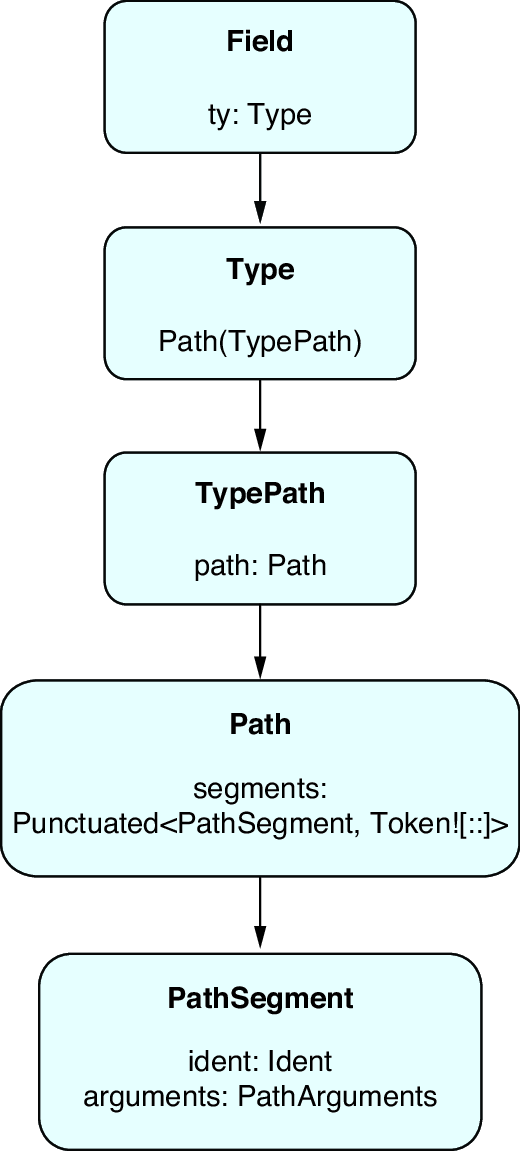
Follow the structural route from a field to the path segment that holds its type identifier. section 6.4.4

