Academic integrity means maintaining honesty, fairness, and responsibility in learning and scholarly work. Generative AI has made these principles harder to apply because students can use machine-generated content beyond classroom oversight, while institutions still debate authorship, attribution, and acceptable assistance. section 6.8 section 6.11
Responsible academic-integrity policies increasingly need to address several connected concerns:
- Define when generative AI use is permitted and require clear attribution where appropriate. section 6.8
- Recognize that outright bans can be difficult to enforce when tools remain available on personal devices and outside school networks. section 6.8
- Treat detection evidence cautiously: classifiers, statistical methods, watermarking, and provenance systems all have limitations. section 6.12
- Consider unequal access and communicate expectations transparently among students, teachers, and institutions. section 6.11 section 6.12
Why detection alone is unsafe
At Texas A&M University–Commerce, a professor mistakenly accused an entire class of cheating after using ChatGPT to assess whether essays were AI-generated. The incident illustrates why uncertain detection should not substitute for fair procedures or reliable evidence. section 6.8
Figure 6.8 Examples of how educators and students can integrate generative AI tools in the classroom
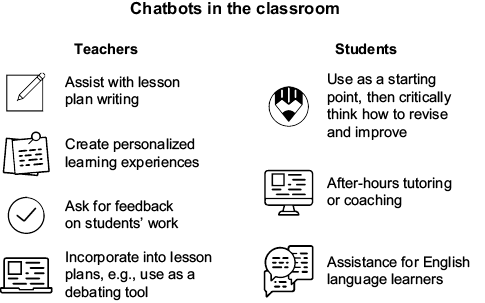
Use the classroom-integration examples to compare academic assistance with expectations for attribution, oversight, and student responsibility. section 6.8
