The access layer is the campus-LAN tier where end hosts and endpoint devices connect to the network. It appears in both two-tier and three-tier hierarchical designs, while its modular blocks can expand as the site grows. section 15.2 section 15.2.1
Typical access-layer responsibilities and characteristics include:
- Connect PCs, phones, servers, security cameras, door locks, and other end-user or endpoint devices. section 15.2.1
- Apply QoS marking early in a packet’s life. section 15.2.1
- Use Port Security, DHCP Snooping, and Dynamic ARP Inspection to secure the user connection point. section 15.2.1
- Provide Power over Ethernet for devices such as IP phones, wireless access points, and cameras. section 15.2.1
Access layer in a collapsed-core LAN
In a two-tier campus design, access switches connect endpoint devices and uplink to distribution switches. The distribution layer aggregates those connections, connects onward to the WAN or internet, and combines the core and distribution roles. section 15.2.1
Figure 15.2 A three-tier campus LAN spanning three buildings. End hosts connect to the access layer, the distribution layer aggregates connections from the access layer, and the core layer aggregates connections from the distribution layer.
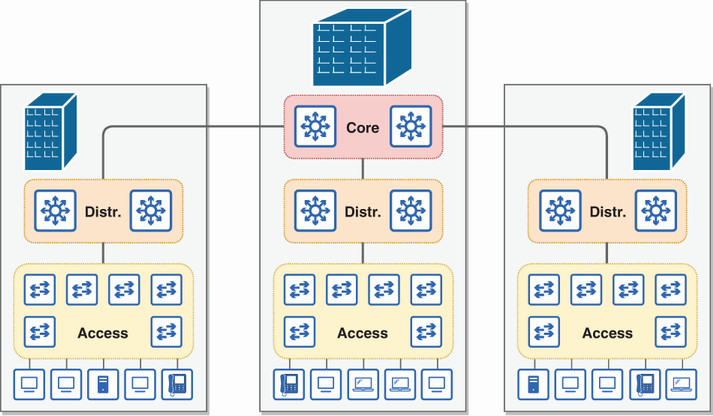
Use the campus diagram to trace endpoint connections through access blocks toward distribution and core layers. section 15.2
