Accuracy tolerance is the predictive-accuracy degradation an application can accept. In post-training quantization (PTQ), it helps determine whether a quantized model is good enough to deploy or needs quantization-aware training (QAT). section 4.1
Use tolerance alongside the model and deployment constraints:
- Tasks with clear classification boundaries can tolerate more quantization error; generation is more sensitive because small logit shifts compound across tokens. section 3.6
- A large CNN targeting INT8 with a 2% tolerance is described as a PTQ-trivial case; low tolerance makes aggressive quantization riskier. section 4.1
Low tolerance raises the risk
A small, attention-heavy model targeting INT4 for medical imaging combines unfavorable architecture, size, bit-width, and tolerance factors; the example indicates it will almost certainly need QAT. section 4.1
Figure 4.2 PTQ decision framework flowchart. Starting from the target bit-width at the top, the reader follows branching decisions through model architecture checks, calibration method selection, and accuracy validation gates. Each terminal node recommends either shipping the PTQ result or escalating to QAT.
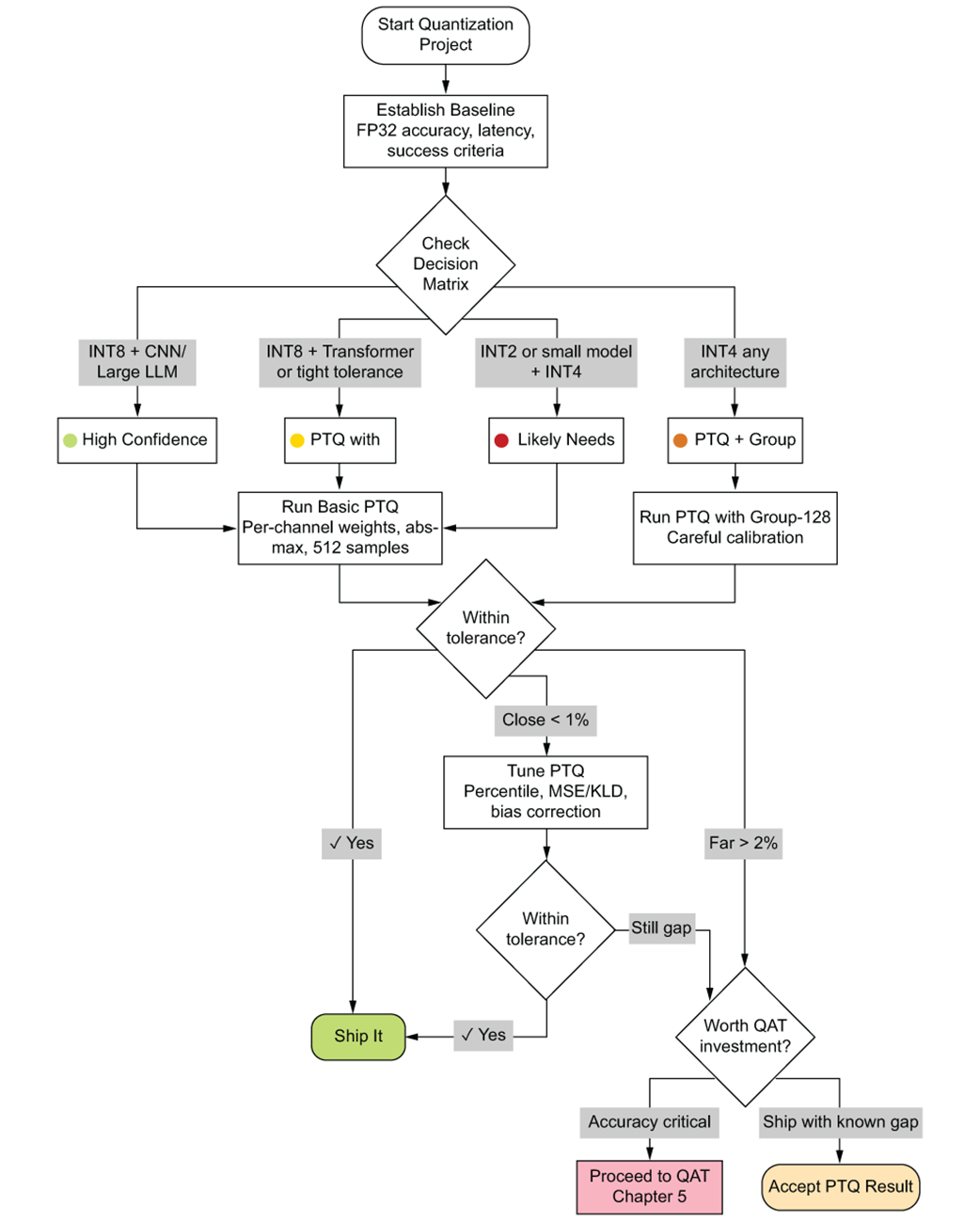
Follow the PTQ decision framework through architecture and calibration choices to accuracy validation, then decide whether to ship PTQ or escalate to QAT. section 4.1
