liveBook · Manning

ACH field

As explained in Build Financial Software with Generative AI (From Scratch)

An ACH field is a value-bearing data element within an ACH record that occupies a prescribed fixed position and length.

An ACH field is a value-bearing element inside an ACH record. Its position and length are prescribed, so parsing depends on reading exact character ranges rather than flexible separators. section 2.3 section 2.4.2

Treat each ACH field as part of a positional contract:

  • Read the field from its defined character range within a 94-character record. section 2.3 section 2.4.2
  • Preserve field order because both record order and field order affect processing and validation. section 2.4.2

Extracting fields with Python slices

A parser can map fixed ranges to named values: an entry-detail record reads transaction_code from line[1:3], account_number from line[12:29], and amount from line[29:39]. The slice boundaries implement the ACH field layout. section 2.4.2

Figure 2.2 ACH file layout
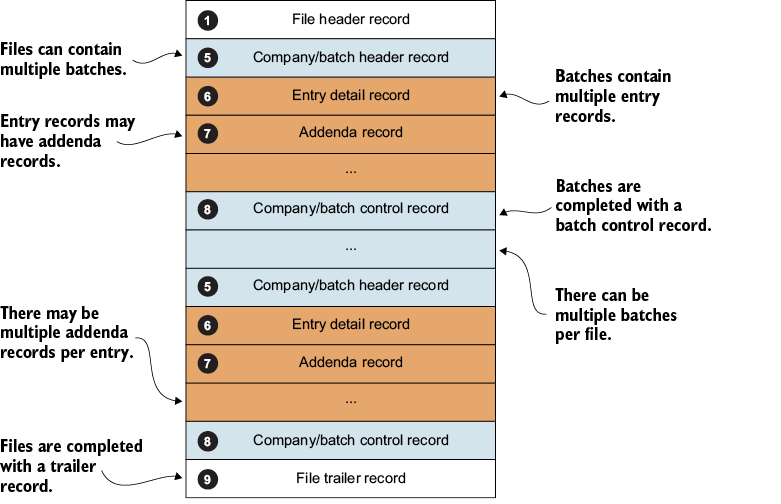
Use the ACH file layout to see how fields fit inside headers, entries, addenda, and control records. section 2.3

How Build Financial Software with Generative AI (From Scratch) covers it

How deep it goes
Defines positional fields and demonstrates Python slicing, but stops short of detailing every field's specification or validation rule.
Examples
Uses file, batch, and entry-detail parser mappings with transaction code, account number, amount, and company name fields.
What it assumes
Assumes basic programming familiarity while introducing ACH records, fixed-width formatting, and positional parsing.
What you can do after
Build it from scratch by extracting named ACH values from fixed-position records in a Python parser.
How it connects
Connects ACH fields to ACH records, fixed-width files, record ordering, parsing, and input validation.

Related concepts

This explainer was generated by Manning's knowledge graph from the text of Build Financial Software with Generative AI (From Scratch). The section links point to the parts of the book it draws on.