ACID names four properties of conventional transactions: atomicity, consistency, isolation, and durability. Together, they describe how a transaction preserves valid data while preventing partial or prematurely visible changes. section 7.4.2
The properties divide transactional behavior into four guarantees:
- Atomicity completes every operation or rolls back the entire transaction, preventing partial updates. section 7.4.2
- Consistency moves the system between valid states while preserving defined rules and data-integrity constraints. section 7.4.2
- Isolation hides intermediate transaction states from concurrent readers. section 7.4.2
- Durability makes committed changes permanent despite system failure. section 7.4.2
Kafka applies transactional ideas to a read-process-write pipeline rather than presenting only database-style transactions. Kafka transactions coordinate consuming input events and producing output events, supporting exactly-once semantics across retries and failures. section 7.4.2
Order processing across downstream topics
An OrderService reads an event from ORDERS, processes it, and writes corresponding events to SHIPMENTS, BILLING, and INVENTORY. Exactly-once processing ensures that each input order produces one event in each destination, avoiding duplicates or omissions when the service fails. section 7.4.2
Figure 7.24 OrderService reads, processes, and writes each event atomically.
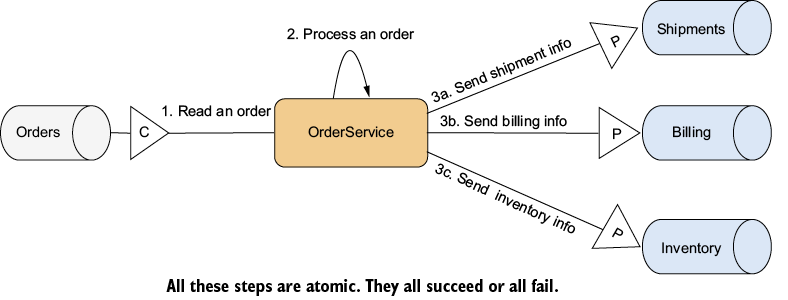
Visualizes an OrderService reading, processing, and writing each event atomically. section 7.4.2
Figure 7.27 Isolation levels determine whether consumers can read uncommitted messages. This figure shows two consumers with different isolation settings.
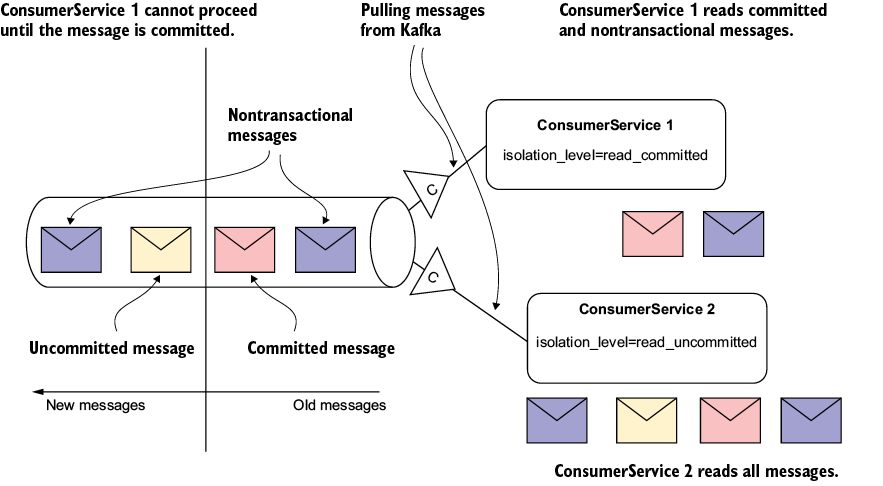
Shows how isolation settings determine whether consumers can read uncommitted messages. section 7.4.2






