An acquisition function is a decision rule for Bayesian optimization: it turns a probabilistic model of an expensive objective into a numerical score for each candidate query. A high score means that evaluating that location is expected to be useful for finding the global optimum. Choose the candidate that maximizes the score, evaluate the objective there, add the result to the observed data, retrain the model, and repeat. section 1.2.2 section 4.1.1
The score should not merely chase the largest predicted value. It can value a location because it looks promising, because its outcome is uncertain, or because both signals together make it worth testing. This is the exploration–exploitation trade-off: exploitation concentrates evaluations in high-performing regions, while exploration learns about uncertain regions that may contain a better result. section 1.2.2 section 4.5
Figure 1.4 A BayesOpt policy scores each individual data point by its usefulness in locating the global optimum. The policy prefers high predictive values (where the payoff is more likely) as well as high uncertainty (where the payoff may be large).

Compare the predictive distribution with the score curve: useful candidates can arise from high predicted payoff or from uncertainty with substantial upside. section 1.2.2
A practical acquisition-driven optimization loop is:
- Fit a Gaussian process (GP) to the objective evaluations collected so far. section 1.2.2
- Score candidate inputs with a policy or acquisition function using the GP’s predictive distribution. section 4.1.1
- Maximize the acquisition score to select the next input, then evaluate the expensive objective. section 4.1.1
- Add the observed label to the training data and continue until the evaluation budget is exhausted. section 4.5
Selecting the next one-dimensional query
For a one-dimensional objective over a bounded search space, plot the GP mean and confidence interval above an acquisition-score curve. The peak of the lower curve identifies the next query. In BoTorch, optimize_acqf() takes a policy and bounds and returns a point that maximizes its acquisition score. Expected Improvement is one policy whose scores can balance improving on the current best value with investigating uncertainty; Probability of Improvement can be more exploitative and risk-averse. section 4.1.1 section 4.5
The score’s meaning depends on the policy. Improvement-based policies value prospective improvement over the best observed value, while information-theoretic policies can value information gained about the objective’s maximum. No single policy is consistently best across all objectives, so inspect optimization progress and adjust the policy when its recommendations waste evaluations or converge poorly. section 4.1.1 section 4.5 section 7.4.1
Figure 7.4 Queries made in the batch setting if we were to simply pick out the points with the highest acquisition scores, denoted by the vertical ticks on the lower curve. These queries are close to each other and are less useful than if they were more spread out.
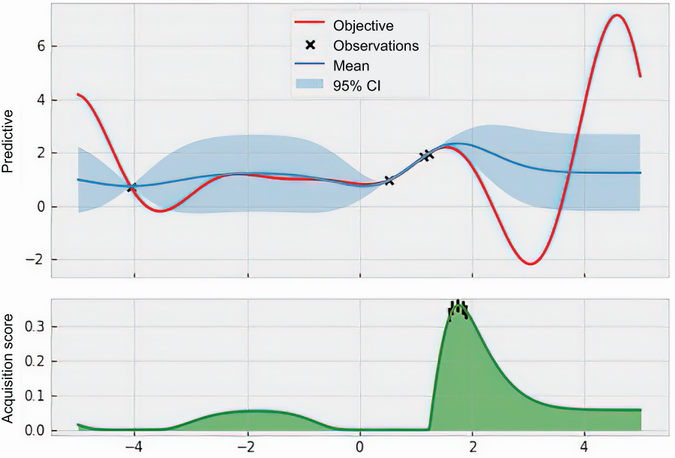
Selecting the individually highest sequential scores for a batch can cluster queries near one location, wasting parallel evaluations. section 7.1.2
Batch optimization changes what a useful score must represent. When several objective evaluations can run in parallel, selecting the top individual scores may produce nearly identical queries. Batch policies instead need to assess the usefulness of the collection, favoring points that provide complementary value. For batch maximum-value entropy search, the joint information score is well-defined but costly to compute and difficult to optimize; cyclic refinement offers a way to improve batch members in turn. section 7.1.1 section 7.1.2 section 7.4.1


