An activation range is the span of values a neural network produces across inputs. In post-training quantization, calibration data estimates the ranges used to set quantization grids. Ranges that are too wide waste precision; ranges that are too narrow clip values. section 4.2
Input conditions change layer ranges
For ResNet-18, Layer 1 activation maxima are 3.07 for low-contrast images and 5.91 for high-contrast images. Calibrating on just one condition can misestimate production ranges. section 4.2
Figure 4.4 Left: Sample images under four conditions (original, low-light, high-contrast, noisy) showing the visual transformations applied to STL-10 images. Right: Layer-wise activation maximums through ResNet-18, where each line corresponds to one condition. Notice how low-light images produce consistently lower activation ranges while high-contrast images push activation maximums higher in deeper layers—calibrating on only one condition would systematically mis-estimate the ranges encountered in production.
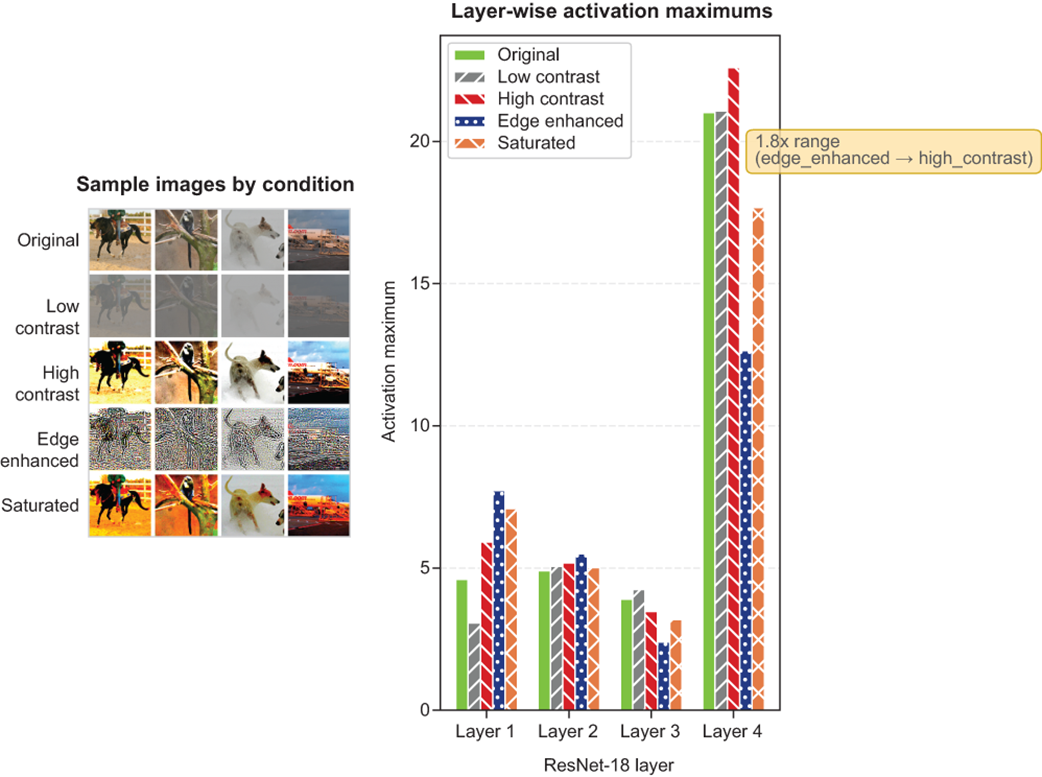
Compare activation maxima across image conditions and layers to see how input variation shifts the estimated ranges. section 4.2