More data does not automatically improve a model: duplicate, overly similar, or extremely noisy samples may add little value. Active learning focuses dataset growth on examples most likely to teach the model something new. section 6.4
Use model behavior to prioritize examples for labeling or inclusion:
- Select samples where the model made mistakes, using human-in-the-loop signals when available. section 6.4
- Prioritize samples where the model has the lowest confidence. section 6.4
- Treat active learning as one option alongside sampling strategies for huge, imbalanced, duplicate-heavy datasets. section 6.4
PhotoStock search labels
For query–image relevance labels, begin with randomly selected pairs from historical queries and the photo library. Later, direct labelers toward pairs where the model is less confident or makes more errors, improving labeling efficiency. section 6.7.2
Figure 6.4 A schematic view of the main differences between aleatoric and epistemic uncertainties (source: “Explainable Uncertainty Quantifications for Deep Learning-Based Molecular Property Prediction” by ChuI Yang and YiPei Li, https://mng.bz/n0ZV)
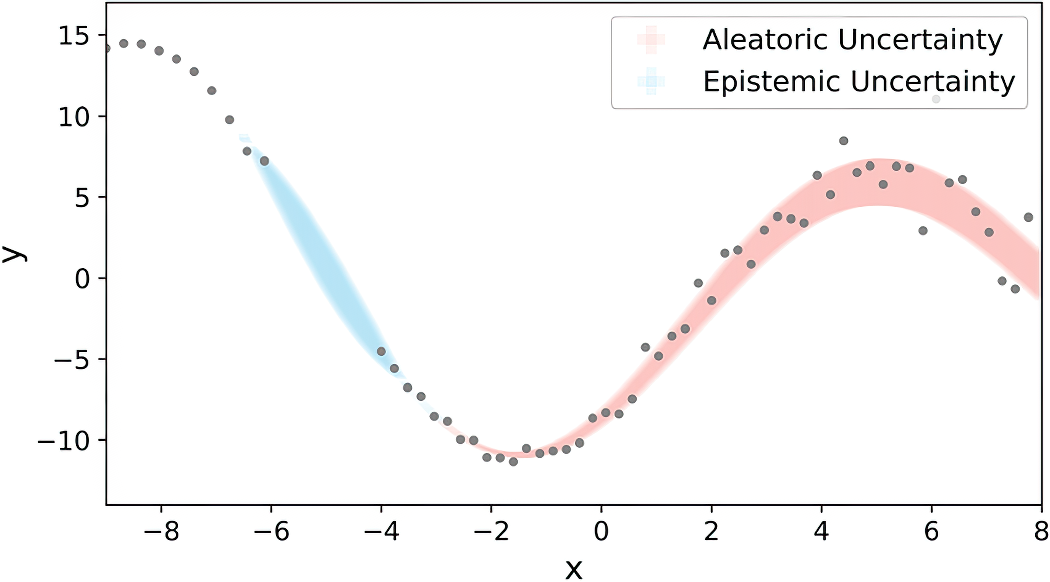
Use the uncertainty schematic to frame why low-confidence examples can be valuable targets for review and labeling. section 6.4


