liveBook · Manning

Actor supervision

As explained in Akka in Action, Second Edition

Actor supervision is a fault-management pattern in which parent actors monitor child actors and respond to their failures.

Actor supervision is a fault-management pattern: parent actors monitor child actors and respond when children fail. In an actor-based application, supervision is one of four core actor operations, alongside creating actors, sending messages, and designating the next behavior. These operations are asynchronous. section 1.6.2

Use supervision to structure application components as actors with explicit responsibility boundaries. Asynchronous message passing keeps actors from sharing mutable state, while supervision supplies a parent-child relationship for handling component failure. section 1.6.2

Supervising application components

A TeamFinder component can supervise contacts actors, making the parent-child relationship visible in the application structure. section 1.6.2
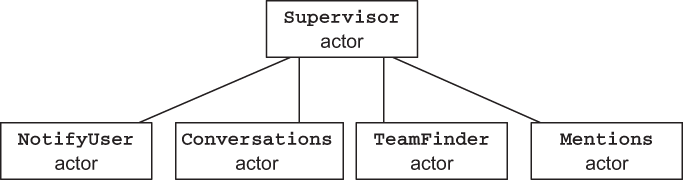
Figure 1.18 Supervising actors
CH01_F18_Abraham2

Inspect the supervision diagram to see how actor supervision is represented as a distinct actor operation. section 1.6.2

How Akka in Action, Second Edition covers it

How deep it goes
Introduces supervision as a core asynchronous actor operation without detailing specific failure-response strategies.
Examples
Illustrates supervision with a TeamFinder actor supervising contacts actors and a supervision diagram.
What it assumes
Introduces actor operations while explaining asynchronous message sending and the absence of shared mutable state.
What you can do after
Evaluate/understand supervision as an actor-model operation for structuring fault-management relationships.
How it connects
Connects supervision with actor creation, message sending, behavior designation, asynchronous messaging, and mutable-state isolation.

This explainer was generated by Manning's knowledge graph from the text of Akka in Action, Second Edition. The section links point to the parts of the book it draws on.