An actuator converts data or control commands into physical quantities, producing mechanical action that changes a robot or its environment. In software terms, it exposes a known input-output API while hiding hardware details. section 1.2.6
Within a robot system, an actuator:
- Receives commands from acting after planning selects the next action. section 1.2 section 1.2.5
- Converts digital input into a physical result, reversing the sensor direction from physical quantity to data. section 1.2.6
- Hides implementation details behind an interface, although hardware effects depend on surfaces, payloads, and other external factors. section 1.2.5 section 1.2.6
From command to physical effect
A position sensor converts rotation into angular data; a controlled motor converts commanded angular data back into rotation. A heating element similarly converts input data into heat. In the ReBo(o)t robot, one actuator helps reboot a crashed computer after a light sensor detects the relevant condition. section 1.2.6 section 3.1
Figure 1.1 The conceptual structure of a robot system forms a continuous loop across six essential parts. Sensors acquire raw data from the environment, which sensing processes into meaningful information. Planning uses this information to calculate the next action, which acting translates into physical commands for actuators that ultimately alter the environment.
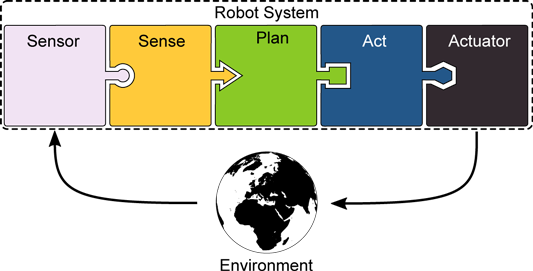
Trace the complete environment-sensor-sensing-planning-acting-actuator loop and see how actuation closes the cycle by changing the environment. section 1.2

