liveBook · Manning

AdaGrad

As explained in Math and Architectures of Deep Learning

An adaptive gradient optimization method that decreases the effective learning rate for parameters that have received large historical gradients.

AdaGrad adapts the learning rate separately for each parameter dimension. This addresses asymmetric loss surfaces, where one shared learning rate may make steep dimensions oscillate while leaving shallow dimensions slow to progress. section 9.2.7 section 9.0

It maintains a state vector containing the cumulative sum of squared partial derivatives for every dimension. Historically large gradients produce larger accumulated values and therefore smaller effective learning rates; historically small gradients retain larger effective learning rates. A small ε prevents division by zero, after which weights and biases receive the adjusted update. section 9.2.7

A speaking-time analogy

AdaGrad gives less attention to dimensions that have produced large slopes repeatedly and more attention to dimensions that have changed infrequently—like paying less attention to someone who speaks constantly and more to someone who rarely speaks. section 9.2.7

Equation 9.14
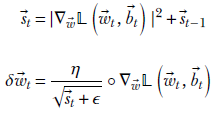
Use the equation figure to inspect AdaGrad’s accumulated-gradient state and per-dimension update. section 9.2.7


How Math and Architectures of Deep Learning covers it

How deep it goes
Derives the squared-gradient accumulator, unrolled history, ε adjustment, and weight-and-bias updates.
Examples
Uses steep-versus-shallow loss-surface dimensions and a speaking-frequency analogy to explain adaptive emphasis.
What it assumes
Assumes gradients, partial derivatives, parameter vectors, learning rates, and iterative loss minimization.
What you can do after
Evaluate how historical gradient magnitudes alter each parameter’s effective learning rate.
How it connects
Connects loss surfaces and gradient descent with momentum, Nesterov, Adam, and optimization.

Also explained in

Compare how 2 books explain AdaGrad →

Related concepts

This explainer was generated by Manning's knowledge graph from the text of Math and Architectures of Deep Learning. The section links point to the parts of the book it draws on.