liveBook · Manning

Adaptive request batching

As explained in Designing Deep Learning Systems: A guide for software engineers

Dynamic batching is the runtime aggregation of separately arriving inference requests into batches for joint execution.

Adaptive request batching aggregates separately arriving inference requests at runtime, allowing them to execute jointly. In Triton, each model has a configurable scheduler that can batch requests before passing them to the model backend. section 7.4.3

A production serving path assigns batching responsibilities as follows:

  • Accept inference requests through REST or gRPC interfaces. section 7.4.3
  • Configure batching independently for each model scheduler. section 7.4.3
  • Pass batched inputs to the backend that executes the model and return the outputs. section 7.4.3

Batch-capacity configuration

A Triton model configuration can declare max_batch_size: 8, alongside input and output tensor specifications. The scheduler can use that model-level capacity when forming inference batches. section 7.4.3

Figure 7.10 Triton Inference Server high-level architecture (Source: NVIDIA Developer, https://developer.nvidia.com/nvidia-triton-inference-server)
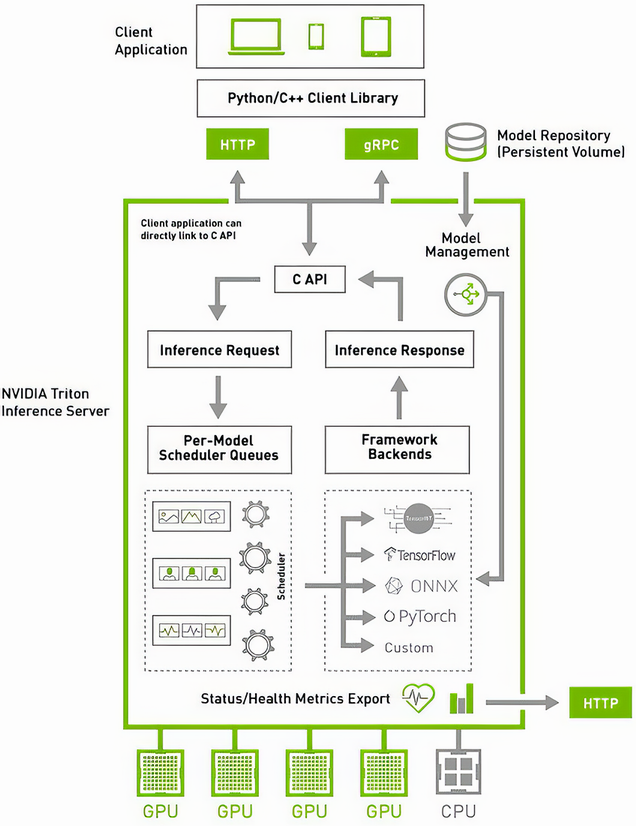
Use the architecture figure to trace requests from the serving interface through model schedulers and backends to returned outputs. section 7.4.3


How Designing Deep Learning Systems: A guide for software engineers covers it

How deep it goes
Explains scheduler placement and model-level configuration but stops short of detailing queue timing or batching algorithms.
Examples
Uses Triton’s REST or gRPC request path and a model configuration declaring max_batch_size: 8.
What it assumes
Assumes familiarity with inference requests and model serving, while locating batching within schedulers and backends.
What you can do after
Operate and configure model-level batching in Triton while selecting compatible backends and serving infrastructure.
How it connects
Connects inference serving with model schedulers, model repositories, model backends, and GPU or CPU execution.

Also explained in

Compare how 2 books explain adaptive request batching →

Related concepts

This explainer was generated by Manning's knowledge graph from the text of Designing Deep Learning Systems: A guide for software engineers. The section links point to the parts of the book it draws on.