Adaptive simulated annealing (ASA) changes search parameters or operators as conditions change, helping balance broad exploration with focused exploitation. It extends simulated annealing when fixed settings or a weak cost function limit progress. section 5.2.5 section 5.7
Useful adaptation strategies include:
- Change reward and penalty weights during the search, relaxing constraints early and enforcing them more strongly later. section 5.2.5
- Adjust the temperature schedule and other parameters automatically, reducing the amount of manual tuning to the cooling rate. section 5.2.5
- Combine ASA with greedy search to speed convergence while adapting cooling, greedy iterations, acceptance behavior, and compulsive accepts. section 5.2.5
Routes with tied edge counts
Two feasible routes can contain the same number of edges, producing Δf = 0. Edge count then provides a poor cost signal; dynamically weighted rewards and penalties can represent constraints more effectively as the search advances. section 5.2.5
Figure 5.9 Effect of temperature in SA. High temperatures result in more exploration, whereas a low temperature restricts the exploration and leads to more exploitation in the search space.
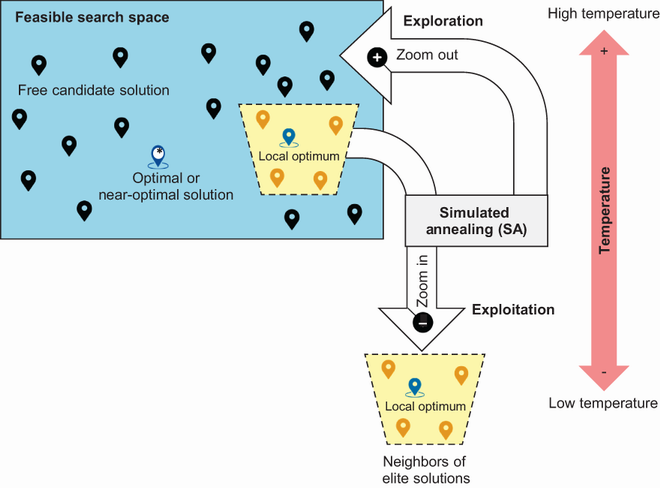
Use the temperature figure to visualize why adaptation matters: high temperatures encourage exploration, while low temperatures restrict exploration and favor exploitation. section 5.2.5
