Adaptive tuning changes algorithm parameters during a search by using feedback from the observed search process. It helps balance exploration and exploitation instead of relying only on values fixed before execution. section 6.2.3 section 8.5
Distinguish three parameter-control approaches:
- Deterministic tuning follows a predefined update rule without using search information. section 6.2.3 section 8.5
- Adaptive tuning uses search feedback to change a parameter, while self-adaptive tuning changes the update rule itself. section 6.2.3
- In tabu search, dynamically varying tabu tenure can respond to cycling or stagnation: short tenures risk repetition, while long tenures restrict exploration and increase memory demands. section 6.2.3
- In genetic algorithms, population size can increase when improvement stalls or decrease when diversity becomes excessive. section 8.5
Rechenberg’s 1/5 success rule
For Gaussian mutation, monitor recent mutation success. Increase the standard deviation when more than one mutation in five improves the solution, encouraging exploration; otherwise decrease it, favoring exploitation. Apply the update every generation. section 8.5
Figure 8.14 Rechenberg’s 1/5 success rule. Following this rule, the Gaussian distribution’s standard deviation is updated by a constant. The higher the standard deviation, the higher the value of x (i.e., larger step size), the higher the deviation from the current solution (more exploration), and vice versa.
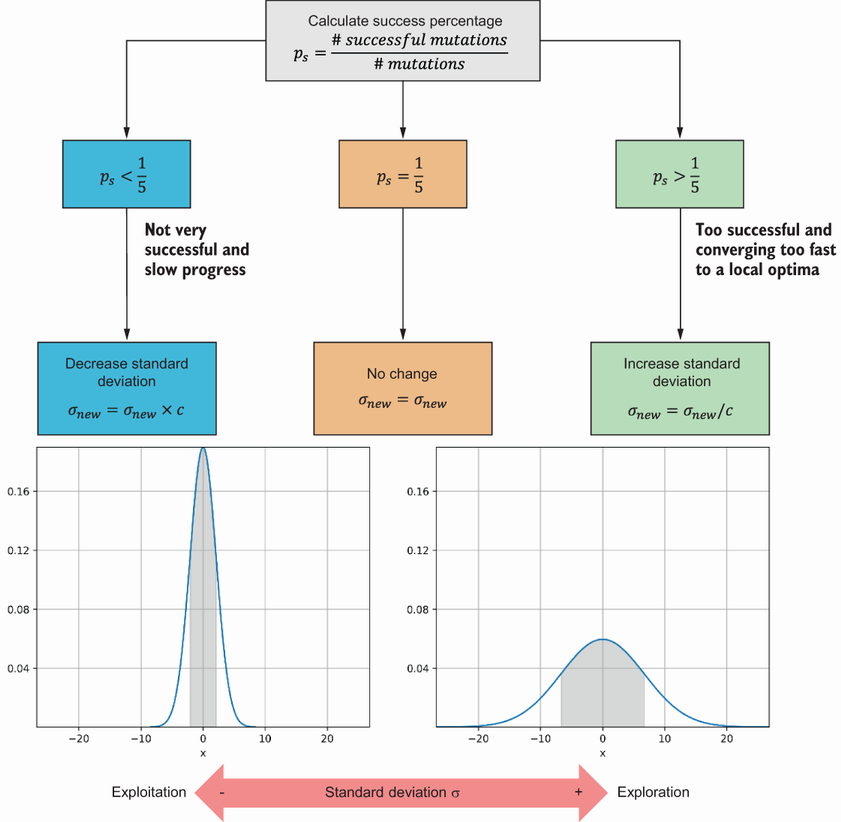
Shows how mutation standard deviation controls step size and therefore the degree of exploration. section 8.5
Figure 6.7 Dynamically controlling the tabu tenure
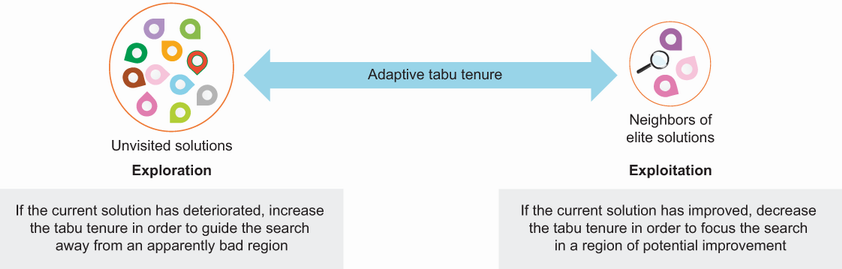
Illustrates dynamic control of tabu tenure during tabu search. section 6.2.3
