liveBook · Manning

Adenosine triphosphate

As explained in Build AI Drug Discovery Pipelines

Adenosine triphosphate is a nucleotide that supplies chemical energy for cellular processes and phosphate-transfer reactions.

Adenosine triphosphate (ATP) is a high-energy nucleotide that supplies phosphate groups for cellular reactions. Protein kinases transfer ATP’s phosphate group to substrate proteins, changing their shape and signaling function. section 8.1.1

ATP matters in drug discovery because many kinase inhibitors bind the conserved ATP-binding site. That conservation can produce off-target activity across the kinase family, making computational selectivity analysis valuable. section 8.1.1

Kinase signaling

A kinase transfers a phosphate group from ATP to a substrate protein; the resulting shape change activates or inactivates signaling pathways and downstream proteins. section 8.1.1

Figure 8.2 Map of human protein kinases, i.e., the Manning kinome tree, clustered based on sequence similarity into eight major groups [3].
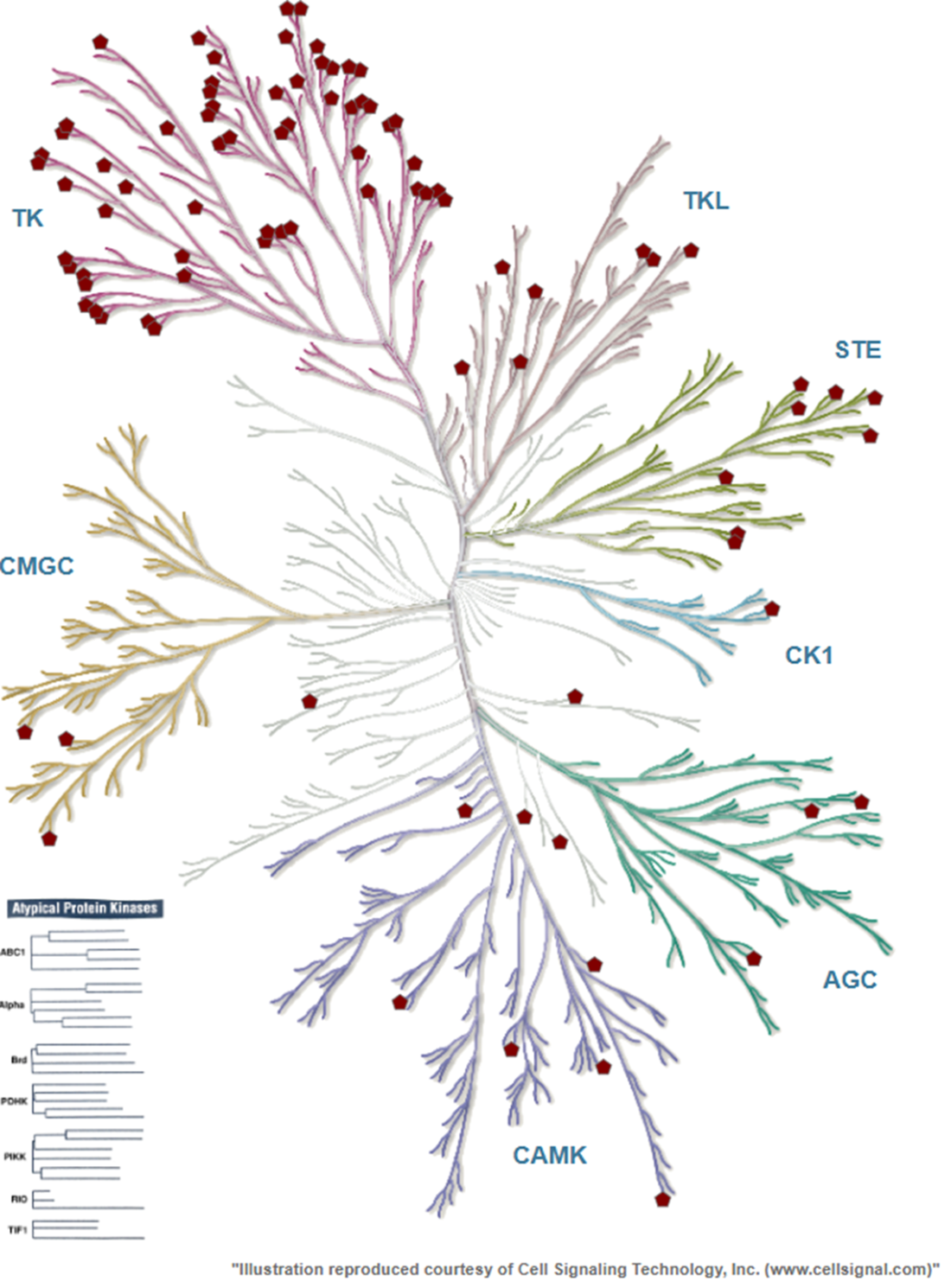
The human kinome tree provides context for the broad kinase family whose conserved ATP-binding sites complicate inhibitor selectivity. section 8.1.1

How Build AI Drug Discovery Pipelines covers it

How deep it goes
Defines ATP and explains phosphate transfer and signaling effects, stopping before molecular structure or computational implementation.
Examples
Uses kinase catalysis, substrate phosphorylation, conserved ATP-binding sites, and the human kinome as concrete reference points.
What you can do after
Understand how ATP-dependent phosphorylation creates opportunities and selectivity challenges for kinase drug discovery.
How it connects
Connects phosphate transfer to protein kinases, substrate proteins, signaling pathways, ATP-binding sites, and kinase inhibitors.

This explainer was generated by Manning's knowledge graph from the text of Build AI Drug Discovery Pipelines. The section links point to the parts of the book it draws on.