Adjacent-layer interaction is communication within one computer: each TCP/IP layer provides a service to the layer directly above it. This lets higher layers use lower-layer functions without handling every transmission detail. section 4.3.2
The service chain works downward and supports delivery upward:
- Layer 4 delivers data to the correct application on the destination host. section 4.3.2
- Layer 3 delivers segments to the correct destination host. section 4.3.2
- Layer 2 delivers packets to the next hop, while Layer 1 provides the physical medium for frames. section 4.3.2
How it differs from same-layer interaction
When data is transmitted, higher layers successively encapsulate it as a segment, packet, and frame. At the destination, layers inspect and remove those headers and trailers during de-encapsulation. Communication between matching layers on different computers is same-layer interaction, not adjacent-layer interaction. section 4.3.2 section 4.4
Figure 4.8 Each layer on a host provides services for the layer above it; this is called adjacent-layer interaction. When two hosts communicate, each layer on one host communicates with the same layer on the other host; this is called same-layer interaction.
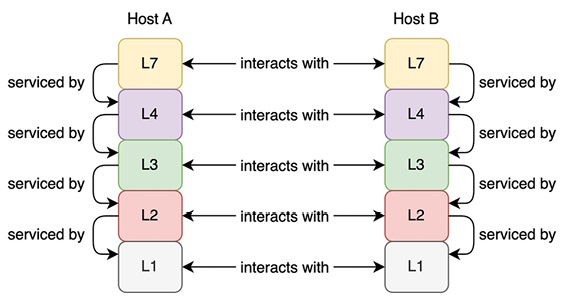
Use the layer-to-layer diagram to distinguish services within one host from communication between matching layers across hosts. section 4.3.2