The adjoint of a complex matrix or linear operator is its conjugate transpose. For a unitary operator, the adjoint is also the inverse, so applying it reverses the operator's action. section 4.3.1
In quantum measurement, an operation can map a noncomputational basis to computational-basis states before measurement. Apply its adjoint afterward when the post-measurement state must match the observed basis state; otherwise, the reversal can be omitted. section 4.3.1
Use these rules when reversing quantum computations:
- Reverse composed operations in the opposite order, beginning with the operation performed last. section 8.2.2
- Reuse the original computation for uncomputation when it implements a classical reversible function F(x, y) = (x, y ⊕ f(x)), because F applied twice returns the input. section 8.2.2
- Uncompute independent constraint checks in any order; do not use that shortcut when later checks depend on earlier results. section 8.2.2
Bell-state measurement
Hadamard followed by CNOT maps computational-basis states to Bell states. To identify Bell states through computational-basis measurement, apply the adjoint: CNOT first, then Hadamard. section 4.3.1
Figure 4.5 Performing a measurement in a noncomputational basis, using the Bell measurement as an example. First, we apply an operation that maps the basis states of the measurement basis (in this case, the Bell states) to the computational basis states. Then, we measure the qubits in the computa-tional basis and interpret the measurement results. Finally, if the state of the system after the measure-ment has to match the measurement outcome, we apply the adjoint of the operation we applied in the first step.
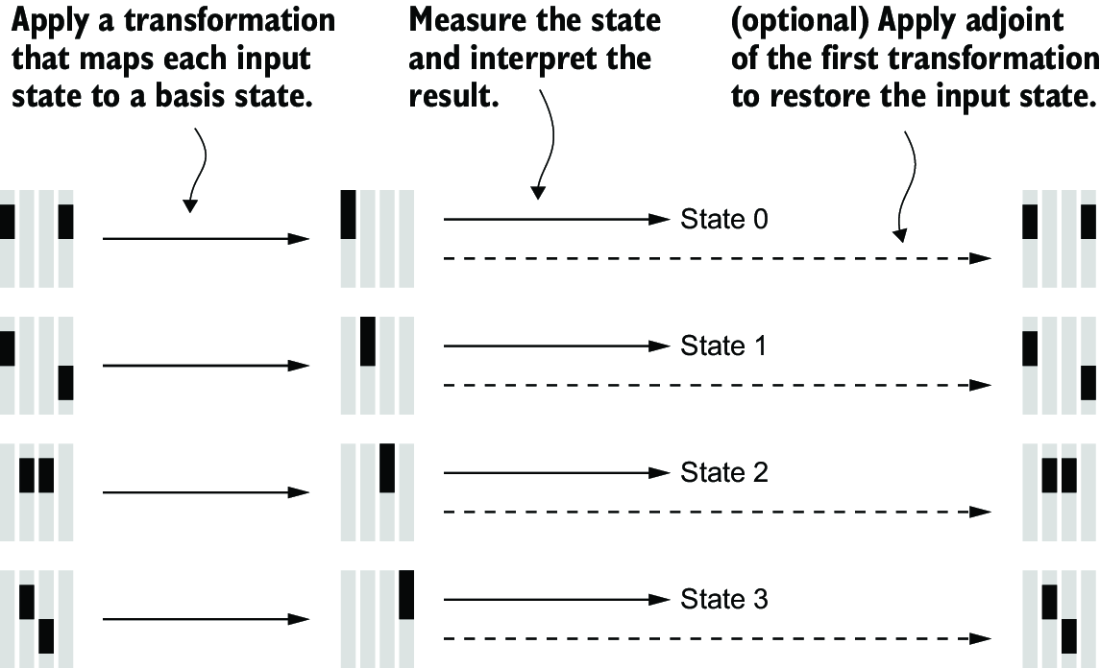
Trace the three-stage noncomputational-basis measurement workflow: transform, measure computationally, and optionally apply the adjoint. section 4.3.1
