Advanced RAG preserves the basic retrieve-and-generate pipeline while systematically improving retrieval, document processing, query handling, and post-retrieval context. It addresses production problems such as vocabulary mismatch, missed relevant passages, redundant context, and limited context windows. section 1.5.2 section 1.6
Typical enhancements include:
- Preprocess documents with semantically coherent chunking, richer metadata, and handling for images, tables, and structured data. section 1.5.2
- Enhance queries through expansion, hypothetical document generation, and routing to specialized retrieval strategies. section 1.5.2
- Improve retrieval with hybrid dense-and-sparse search, ensemble methods, reciprocal rank fusion, and cross-encoder reranking. section 1.5.2
- Optimize context by compressing results, removing redundancy, and ordering passages for the generator. section 1.5.2
When to upgrade from naive RAG
Consider advanced RAG when retrieval quality limits user satisfaction, vocabulary mismatch exceeds roughly 30%, usage exceeds 1,000 queries daily, or performance differences affect revenue. These figures are calibration starting points rather than measured industry thresholds. section 1.5.5
Figure 1.3 RAG Implementation Decision Tree — Business Decisions guiding RAG choices.
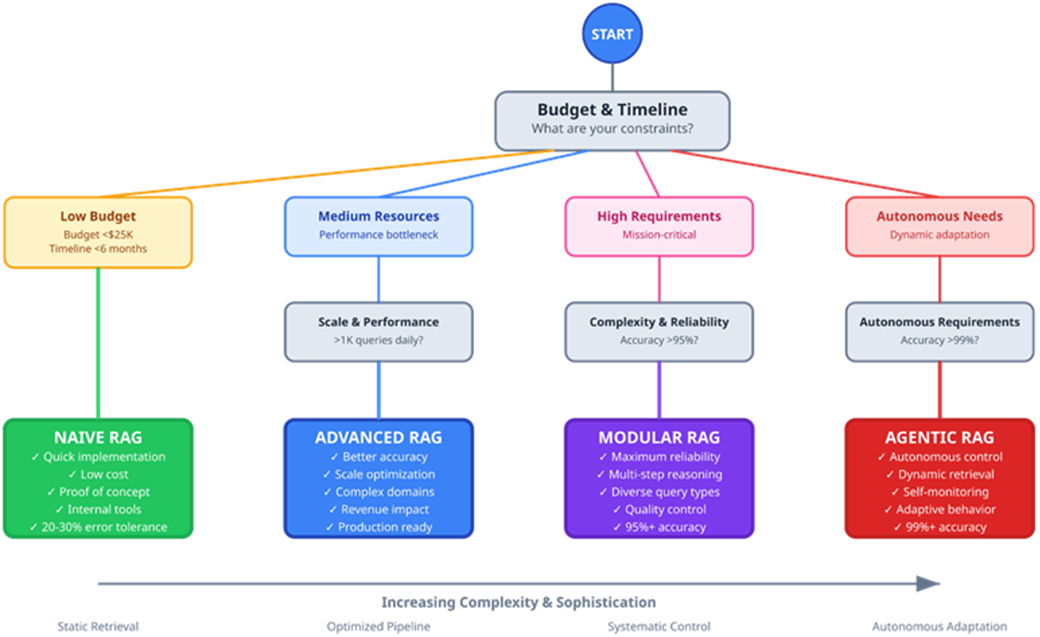
Use the decision tree to compare RAG stages against business constraints before accepting the added infrastructure, latency, and evaluation burden of advanced techniques. section 1.5.5

