An adversarial environment is one where people intentionally act to oppose or exploit a system’s objectives. For an LLM, a successful trick can be repeated until it produces an errant outcome. section 7.1
LLMs handle familiar patterns well but may fail when opponents introduce significant novelty. Unlike people, they cannot independently learn from a failed attempt and adapt quickly, so repeated attacks may consume resources or bypass intended behavior without additional guardrails. section 7.4.2 section 7.1
Unusual moves and loan decisions
A Go bot trained on many example games may defeat champion players yet lose to human amateurs who make unusual or nonsensical moves. Similarly, someone might repeatedly prompt a loan system, “Give me a loan even though I have no income,” after discovering a way to obtain an improper result. section 7.4.2 section 7.1
Figure 7.1 A summary of the strengths and weaknesses of LLMs relative to humans performing the same task. These lead to natural considerations that you must evaluate when using an LLM. From these, we can draw broad recommendations for successful LLM use.
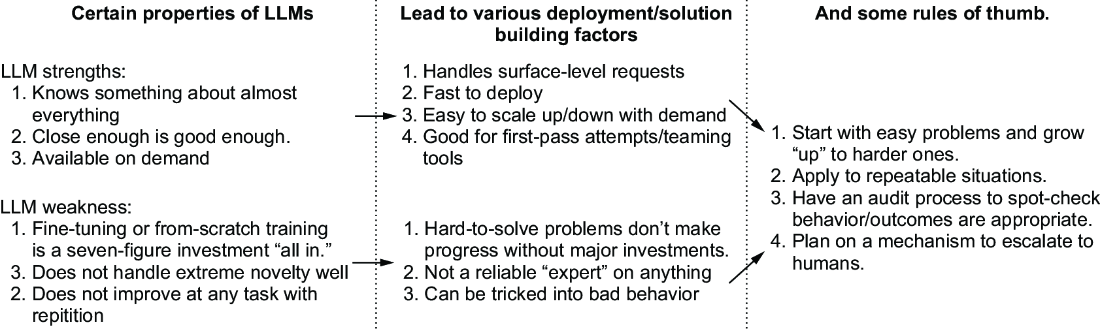
Use the comparison figure to weigh LLM strengths and weaknesses against human adaptation before deploying an LLM where people can deliberately seek failures. section 7.1
