Aerostructural optimization tunes an airplane’s aerodynamic and structural design variables to improve a performance measure. Computer simulations turn each proposed design into a score, making the task a high-dimensional black-box optimization problem when parameter effects are unknown. section 7.5
A simulated design problem can vary:
- Body dimensions such as length and width. section 7.5
- Wing shape and wing angle relative to the fuselage. section 7.5
- Turbine-blade angle and rotational speed. section 7.5
Four-parameter airplane objective
The exercise represents each design with four inputs and evaluates a simulated flight-utility function. The parameters correspond to scaled body length, wing span, ρ, and ω; higher scores represent better designs. section 7.5
Figure 7.19 The objective function of the simulated airplane design optimization problem in various two-dimensional subspaces, corresponding to pairs of tunable parameters, shown as axis labels. Bright spots indicate high objective values, which are our optimization goals; dark spots indicate low objective values.
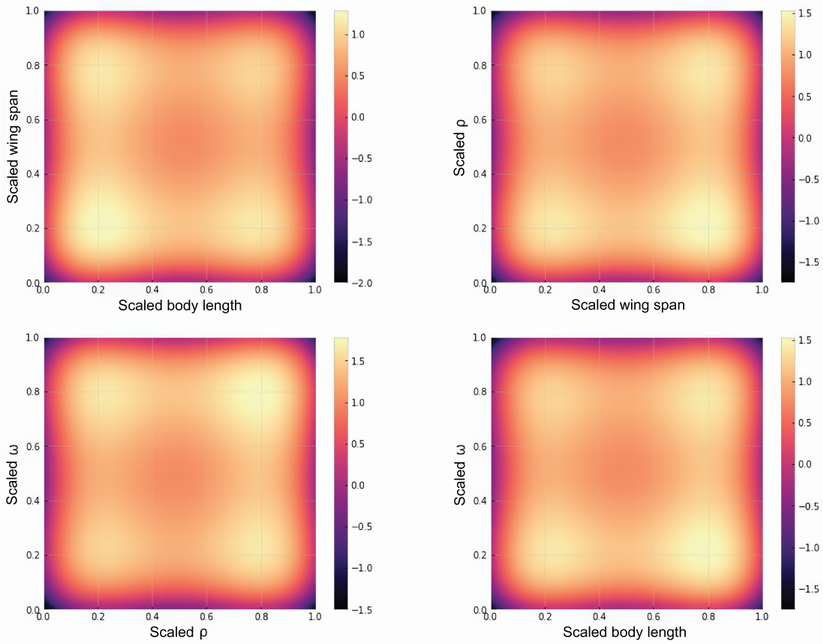
Compare two-dimensional parameter slices: bright regions mark high objective values and identify promising design neighborhoods. section 7.5
