An agent is a persistent candidate solution encoded as a fixed-size vector. Differential evolution modifies its components rather than creating offspring, allowing each candidate to survive across generations. section 4.5.1
During differential evolution, three randomly selected agents produce a trial agent for a target. Each changed component uses a scaled difference: y[i] = a[i] + F × (b[i] − c[i]). The trial replaces the target when its fitness is better. section 4.5.1 section 5.6.1
A DE agent typically participates in this workflow:
- Represent parameters or a candidate solution as a vector with a fixed dimensionality. section 4.5.1
- Sample three population members, clone the target, and choose at least one component for modification. section 4.5.1 section 5.6.1
- Use the crossover rate to modify additional components, evaluate the trial, and retain the fitter candidate. section 4.5.1 section 5.6.1
DEAP representation
A DEAP implementation represents an agent as an array of floating-point values with an attached minimization fitness. The toolbox initializes vector components, builds populations, and randomly selects three agents. Typical parameters include dimensionality, crossover rate, scaling factor, population size, and generation count. section 4.5.1 section 5.6.1
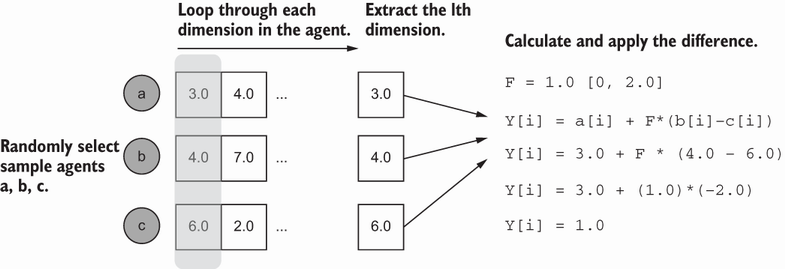
Use the workflow diagram to trace how three sampled agents produce a trial vector and how fitness determines replacement. section 4.5.1
Agents can approximate polynomial, absolute, and step functions, and can encode hyperparameters for optimization. In reinforcement learning, related agents can represent evolving networks, although sparse rewards may fail on complex environments such as lunar lander. section 4.5.1 section 11.4
