liveBook · Manning

Agent-environment interaction loop

As explained in Applied Reinforcement Learning

The recurring reinforcement-learning cycle in which an agent observes a state, takes an action, receives feedback, and reaches a new state.

In reinforcement learning, an agent observes the system’s current state, chooses an action, receives a reward, and moves to a new state. Repeating this cycle lets the agent learn a policy—a mapping from states to actions—that seeks long-term reward. The agent can build knowledge through interaction without having a complete system model in advance, which suits business settings where conditions change. section 1.7

Figure 1.7 Overview of reinforcement learning framework.
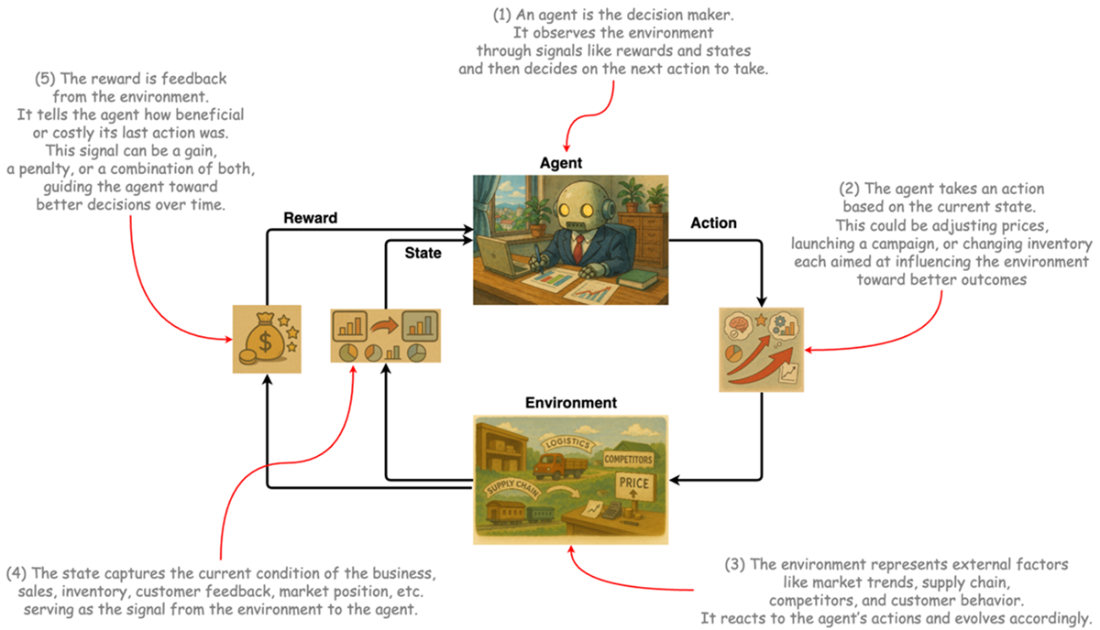
Use the framework diagram to follow how the agent and environment exchange states, actions, and rewards. section 1.7

How Applied Reinforcement Learning covers it

How deep it goes
Traces observation through action, reward, state transition, and policy learning, stopping short of implementation details.
Examples
Uses a manager or company improving through experience as an analogy for repeated feedback.
What you can do after
Understand how repeated interaction can improve a policy toward long-term reward without a complete system model upfront.
How it connects
Links reinforcement learning with states, actions, rewards, policies, sequential decisions, and traditional optimization.

Related concepts

This explainer was generated by Manning's knowledge graph from the text of Applied Reinforcement Learning. The section links point to the parts of the book it draws on.