Agentic search builds context through a continuous plan–act–observe loop. Instead of trusting nearest indexed chunks, an agent searches live files with glob, grep, and reads, then follows references and revises its search. section 3.5.1
The tradeoff is explicit: indexed retrieval is fast but can be stale or arbitrarily chunked; agentic search improves freshness and reference-following at the cost of tokens, latency, and uncertain coverage. Repository exploration consumed 56.2% of tool-use turns and 46.5% of main-agent tokens in one analysis. section 3.5.1
Repository exploration
An agent locates the function to change, searches for usage examples, reads related files, inspects error handling, and iterates when observations reveal missing context. section 3.5.1
Figure 3.7 Context-aware assistance flow. The developer's query is converted into an embedding, matched against the indexed codebase, and the most relevant chunks are injected into the prompt before the model generates its response.
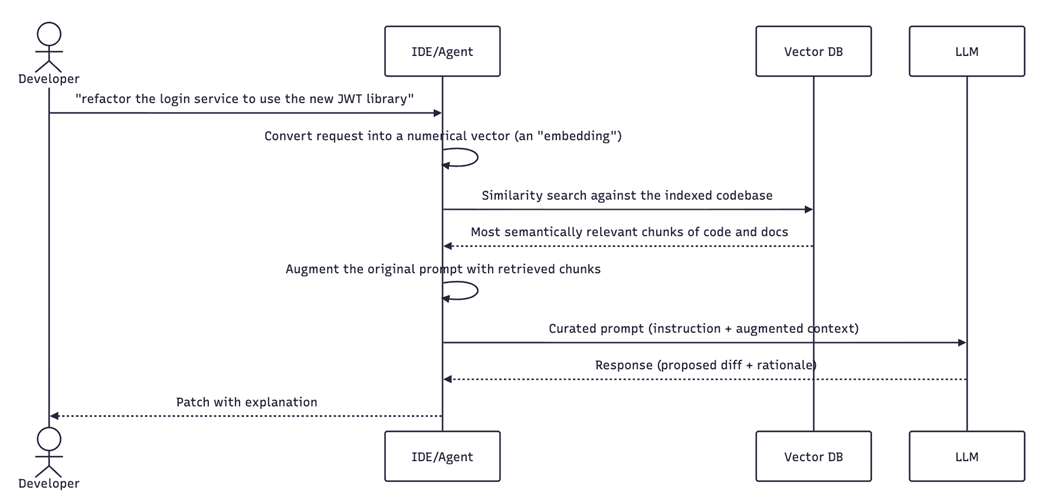
Contrasts agentic context construction with embedding retrieval, where a query is matched against indexed chunks before generation. section 3.5.1
