Agentless design manages devices without installing dedicated management software on each one. A central control node or server connects to managed devices and applies configuration remotely. section 25.2.1 section 25.2
Recognize agentless operation by these characteristics:
- Managed devices need a supported connection rather than a resident agent; Ansible devices must accept SSH connections from the control node. section 25.2.1
- The control node uses a push model: it connects to devices and sends configuration information instead of waiting for devices to retrieve it. section 25.3
- Ansible uses SSH or NETCONF for communication, while Terraform communicates with providers through HTTP APIs. section 25.2 section 25.2.2
- Agentless design differs from Puppet and Chef, which require software agents installed on managed devices and primarily use a pull model. section 25.2.3
Centralized Ansible configuration
An inventory identifies managed hosts, variables supply device-specific values, templates produce configuration files, and a playbook defines the tasks. The Ansible control node then connects over SSH and pushes the resulting configuration without installing Ansible software on the network devices. section 25.2.1
Figure 25.5 Basic Ansible operations. Inventory, template, and variable files define configurations, and playbooks define actions. The control node uses SSH to connect and push configurations to managed devices.
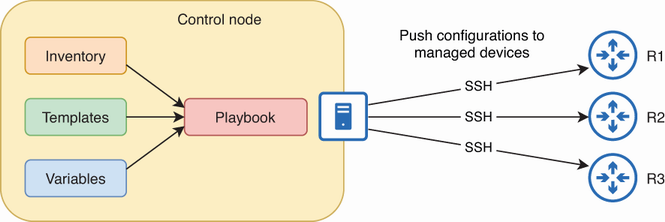
Trace how inventory, template, and variable files define configuration while a playbook directs the control node to push changes over SSH. section 25.2.1
