liveBook · Manning

3d grid

As explained in Applied Reinforcement Learning

A 3D grid is a discrete array indexed along three spatial dimensions for representing occupied or empty container space.

A 3D grid represents container space as a discrete array with three spatial dimensions. In a packing environment, each container gets an initially empty NumPy array; the observation exposes these grids to the agent. section 3.4

Tracking a placement

A proposed item placement specifies a container and (x, y, z) coordinates. The environment checks that the item fits within the grid boundaries and avoids occupied space, then records the item in the array. section 3.4

Figure 3.7 Visualization of one instance of trailer loading and packing environment.
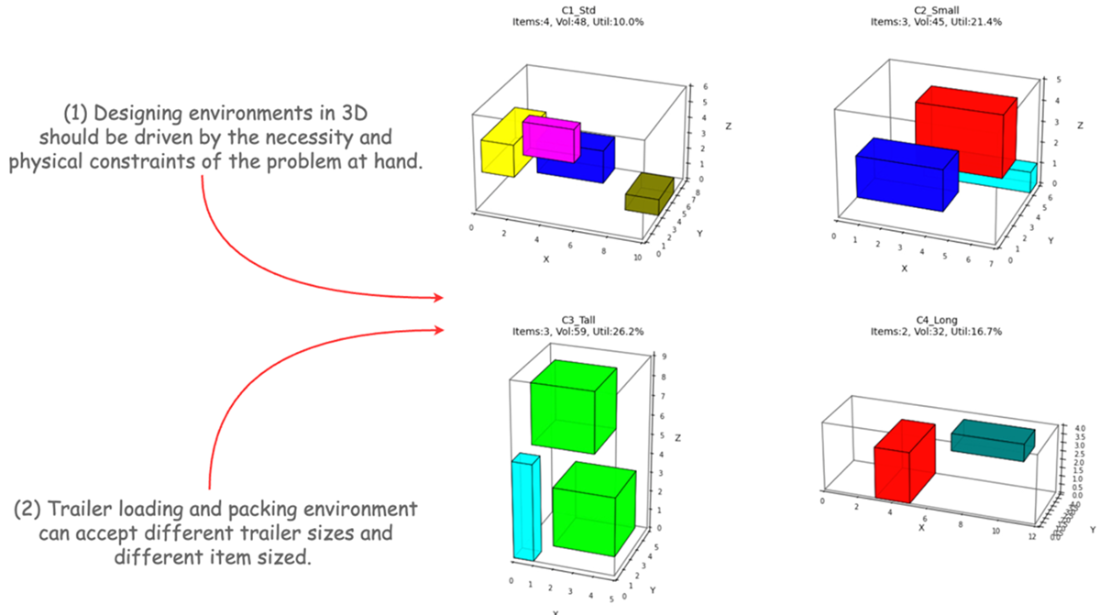
View a trailer-packing example with containers and placed items. section 3.4

How Applied Reinforcement Learning covers it

How deep it goes
Explains empty-array initialization, occupancy observations, and boundary and collision checks for placements.
Examples
Uses empty container arrays and item placements specified by container index and (x, y, z) coordinates.
What you can do after
Build a packing environment that tracks container occupancy and validates proposed placements.
How it connects
Connects container packing with agent observations, NumPy arrays, and spatial placement.

Related concepts

This explainer was generated by Manning's knowledge graph from the text of Applied Reinforcement Learning. The section links point to the parts of the book it draws on.