Trailer loading optimization places a fixed sequence of boxes into one or more trailers to use space efficiently and reduce shipment and transportation costs. It is a 3D bin packing problem with a large decision space, making it a candidate for reinforcement learning. section 3.4
A packing environment models the decision with:
- Items as rectangular boxes and trailers as fixed-dimension containers. section 3.4
- Actions that choose a container, placement coordinates, and one of six box orientations. section 3.4
- Placement checks that reject overlaps or positions outside container bounds; rewards encourage packing items and penalize invalid actions or skipping. section 3.4
A packing decision
A cubic box can be placed in any of the six orientations, while a 4 × 3 × 2 box has dimensions that change with orientation. The chosen placement must fit within the selected trailer without overlapping packed items. section 3.4
Figure 3.7 Visualization of one instance of trailer loading and packing environment.
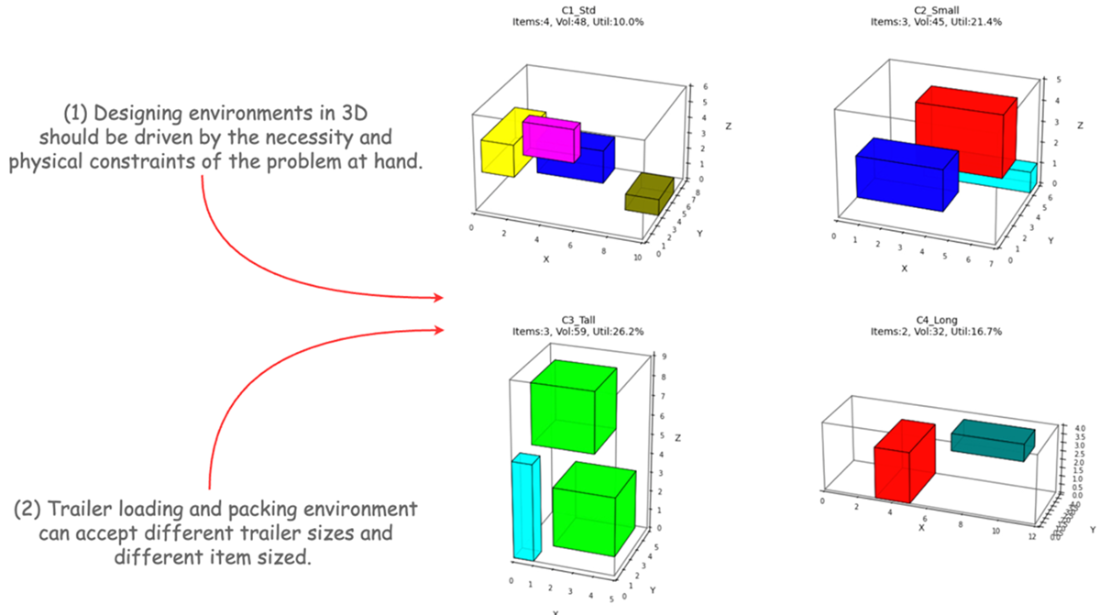
A visualization shows one instance of the trailer loading environment. section 3.4
