liveBook · Manning

Warehouse order picking environment

As explained in Applied Reinforcement Learning

A simulated warehouse setting in which an agent navigates to collect ordered items and return them to a depot.

A warehouse order picking environment models one robot fulfilling one customer order as a sequential decision problem. On a 2D grid, the robot collects fixed-location items around obstacles, then returns to the depot; the objective is to finish in as few steps as possible. section 3.2

The simulation translates the picking task into:

  • A state containing the robot’s position, which items have been picked, and whether collection is complete. section 3.2
  • Four grid moves, with obstacles and boundaries preventing some movement. section 3.2
  • Rewards that favor efficient completion: small movement costs, penalties for invalid moves, rewards for pickups, and a larger reward for returning to the depot. section 3.2
Figure 3.2 A visual rendering of the warehouse environment.
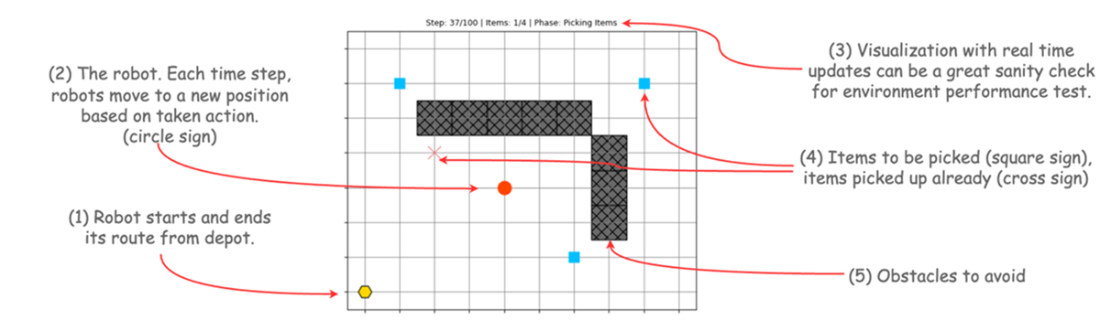
View the rendered grid to see the kind of warehouse world the agent navigates. section 3.2

How Applied Reinforcement Learning covers it

How deep it goes
Defines the grid state, movement constraints, task progression, and reward signals.
Examples
Uses a grid warehouse with a depot, fixed item locations, obstacles, and a random-agent sanity check.
What you can do after
Build it from scratch by defining a grid state, movement and task progression, and reward signals.
How it connects
Connects reinforcement learning with states, actions, policies, rewards, and simulation design.

Related concepts

This explainer was generated by Manning's knowledge graph from the text of Applied Reinforcement Learning. The section links point to the parts of the book it draws on.