liveBook · Manning

AI Code of Practice

As explained in Introduction to Generative AI, Second Edition

The AI Code of Practice is a set of nonbinding guidelines for providers of general-purpose AI models to demonstrate compliance with the AI Act.

The AI Code of Practice is a set of nonbinding guidelines for providers of general-purpose AI (GPAI) models. It helps them demonstrate compliance with the AI Act while legally binding standards are developed. section 10.30

The guidelines ask GPAI providers to:

  • Furnish authorities with training-data summaries, model documentation, and copyright-compliance policies. section 10.30
  • Publish information about model capabilities and limitations for downstream providers building integrations. section 10.30
  • For models with systemic risk, provide evaluation evidence, risk assessments, mitigation measures, cybersecurity protections, and incident-reporting processes. section 10.30

A contested threshold

Systemic risk is defined here partly through a training threshold of at least 10²⁶ floating-point operations (FLOPs). Critics argue that capability or application-based tests could be fairer because smaller models may outperform larger ones, while evaluating every model in depth would be burdensome. section 10.30

Figure 10.7 The four risk categories in the AI Act
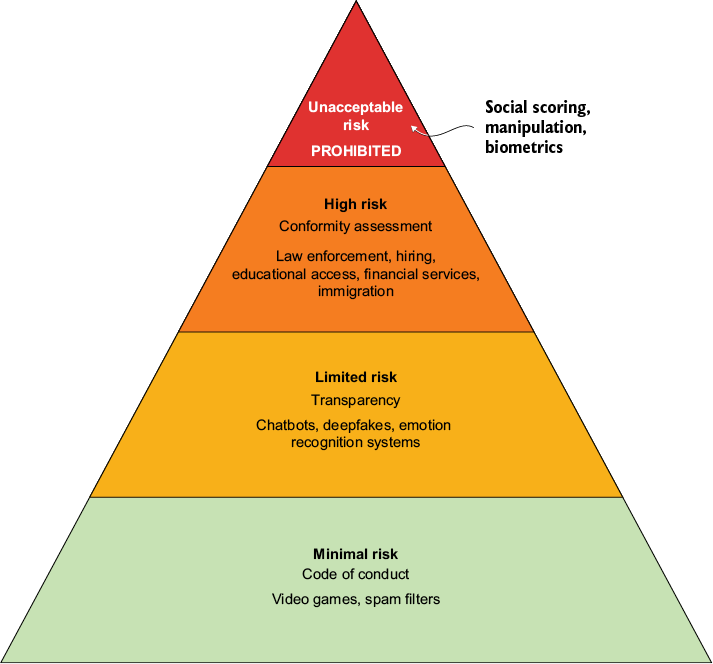
A pyramid of risk levels

AI-generated content may be incorrect.

Use the AI Act’s four risk categories to place GPAI obligations alongside the wider risk-based regulatory framework. section 10.30

How Introduction to Generative AI, Second Edition covers it

How deep it goes
Specifies documentation, transparency, copyright, evaluation, security, and incident-reporting duties, but remains nonbinding.
Examples
Uses training-data summaries, model documentation, capability disclosures, FLOPs thresholds, and systemic-risk safeguards.
What it assumes
Assumes familiarity with general-purpose AI models and the AI Act’s risk-based categories.
What you can do after
Evaluate provider responsibilities and identify evidence needed to demonstrate compliance with GPAI expectations.
How it connects
Connects the AI Act with copyright law, model evaluation, risk assessment, cybersecurity, and incident reporting.

Related concepts

This explainer was generated by Manning's knowledge graph from the text of Introduction to Generative AI, Second Edition. The section links point to the parts of the book it draws on.