An AI executive order is a presidential directive that establishes requirements or policies for artificial-intelligence development, deployment, or oversight. In October 2023, the White House used one to move beyond voluntary commitments by leading AI companies. section 10.29
The order was designed to:
- Require AI companies to share safety evaluations and other information with the government. section 10.29
- Require precautions intended to prevent models from being used for malicious purposes. section 10.29
- Set a strategy for investments in research, development, and talent recruitment. section 10.29
The order sits alongside other forms of AI governance, including enforcement against discriminatory automated decisions and the Blueprint for an AI Bill of Rights. That blueprint offers broad principles, whereas an executive order establishes federal requirements and strategy. section 10.29
Figure 10.6 The five principles listed by the OSTP as a “Blueprint for an AI Bill of Rights” [35]
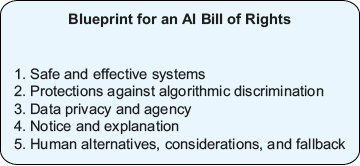
Use the five principles to compare an executive order with broader policy guidance on safety, discrimination, privacy, explanation, and human alternatives. section 10.29
