liveBook · Manning

AI footprint

As explained in The Art of AI Product Development

An AI footprint is an interface representation that lets users trace the steps or intermediate process connecting an AI prompt to its result.

An AI footprint lets users trace the steps between a prompt and an AI result. If a step looks mistaken, the user can identify it in a follow-up prompt and ask for a corrected result. The point is not transparency for its own sake: the trace should help someone judge and act on the output. section 10.2.2

In a conversational interface, explanations can appear within the conversation. When the process is largely opaque, as with a single-step LLM generation, links to sources can offer a more useful shortcut than a step-by-step footprint. section 10.2.2

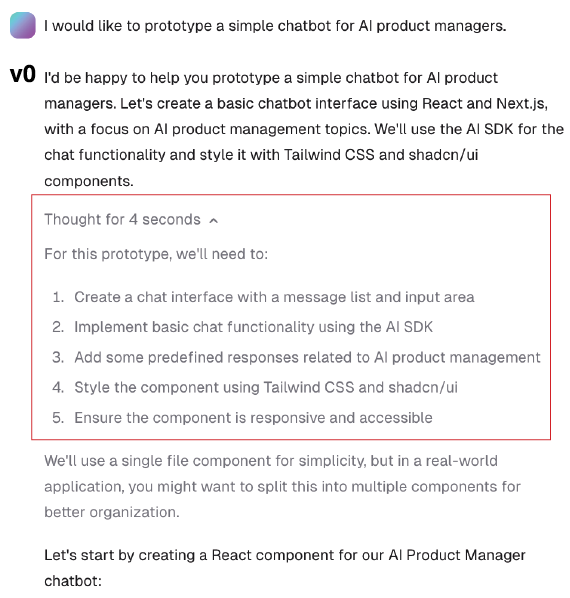
Figure 10.21 Vercel’s v0.dev discloses its CoT, that is, the model’s thinking process, so that the user can revert to problematic steps in a follow-up.
A screenshot of a chat

AI-generated content may be incorrect.

Vercel’s v0.dev illustrates a disclosed thinking process that users can revisit when a step appears problematic. section 10.2.2

How The Art of AI Product Development covers it

How deep it goes
Defines the pattern and describes its use in follow-up prompts, without specifying an implementation procedure.
Examples
Shows Vercel’s v0.dev disclosing a thinking process users can revisit in a follow-up.
What you can do after
Evaluate/understand an AI result by tracing its presented steps and identifying mistakes to address in a new prompt.
How it connects
Connects AI footprints to conversational interfaces, chain-of-thought disclosure, source citations, and trust calibration.

This explainer was generated by Manning's knowledge graph from the text of The Art of AI Product Development. The section links point to the parts of the book it draws on.