AI risk management organizes the identification, assessment, control, and monitoring of risks associated with an AI system across its lifecycle. The European Union’s AI Act applies stronger obligations where systems may affect safety or fundamental rights. section 10.30
The AI Act distinguishes four broad risk levels:
- High-risk systems, including AI used in hiring, law enforcement, education access, and financial-services access, require assessment before market entry and throughout the lifecycle. section 10.30
- Limited-risk systems must meet transparency requirements, such as informing users when they interact with chatbots, deepfakes, or emotion-recognition systems. section 10.30
- Minimal-risk applications, such as video games and spam filters, are mainly addressed through voluntary codes of conduct. section 10.30
High-risk systems must support data governance, accuracy, nondiscrimination, record-keeping, technical documentation, human oversight, and registration in an EU-wide database. Noncompliance can result in large fines. section 10.30
Figure 10.7 The four risk categories in the AI Act
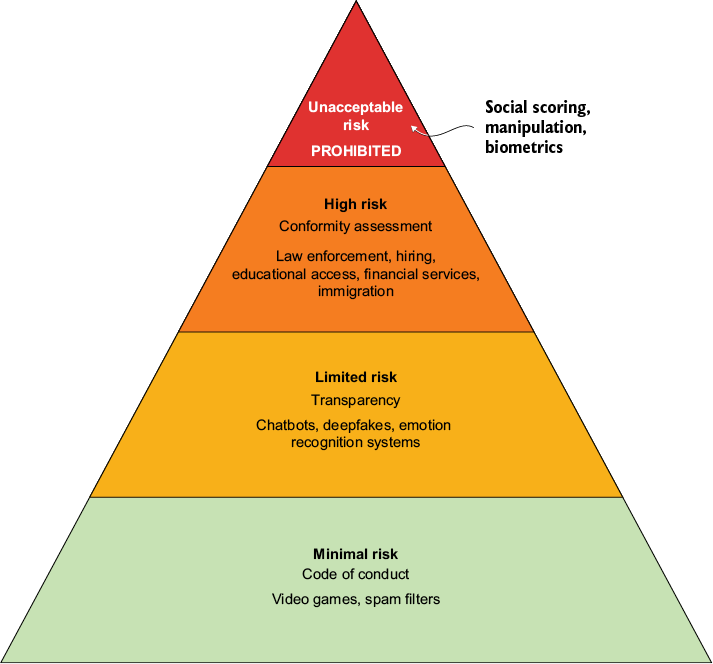
A visual summary of the AI Act’s four risk categories helps compare regulatory intensity across system types. section 10.30
