A social media feed can contain more updates than anyone has time to read. An algorithmic feed helps select or order those updates, often using personalized relevance instead of showing friends’ posts solely in reverse-chronological order. It can also add content from people the user does not follow. section 1.1.1 section 1.2.2
From recent updates to relevant updates
Facebook’s early algorithmic feed used EdgeRank to weight posts and friends. Newer posts received priority, as did updates from friends a user interacted with more often. This simple weighting formula differs from the machine-learning algorithms used by platforms today. section 1.2.2
Interactions can also create a feedback loop: seeing more updates from a friend may lead someone to interact with that friend more, which in turn can make their updates more prominent. The system infers preferences from behavior rather than relying only on an explicit list of interests. section 1.2.2
Figure 1.3 Various social media models. In the Subscription model, the content is seen only by users who explicitly follow the content producer, with no options or resharing. In the Network model, users can also reshare content from users they follow, enabling the distribution of content outside of the immediate network. Finally, in the Algorithmic model, an algorithm can add content to users’ feeds, even with no direct connection to the content itself or its author.
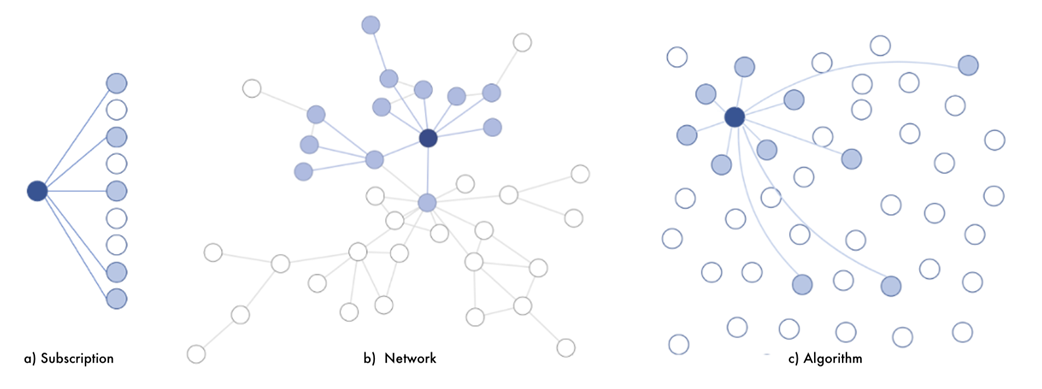
Compare feeds limited to followed accounts with network resharing and algorithmic additions from outside a user’s connections. section 1.2.2
Is one source being amplified?
Suppose a reader follows two news outlets, but one supplies 80% of what they see. That imbalance might signal amplification, but it is not enough to establish it: the outlets may publish different amounts, and the reader’s interests and behavior may also matter. If one account posts once and another posts ten times, seeing all 11 posts produces a ten-to-one difference without algorithmic skew. section 5.5.3
Personalization can make content easier to find and bring people with shared interests together, while platforms can optimize for engagement or time spent. It can also contribute to filter bubbles and more uniform culture. Personalized feeds are difficult to audit from outside, raising the question of whether content is valuable to users or merely engaging. section 1.1.1 section 7.5.2
