Algorithmic recourse identifies the nearest achievable change to an individual’s input features that would produce a preferred machine-learning classification. Unlike a purely descriptive explanation, it answers an intervention-oriented question: what could this person change to obtain a different decision? section 8.1.3 section 8.5
A recourse analysis typically:
- Defines a distance metric over the feature space to identify a minimal change. section 8.1.3
- Searches for a feature vector on the opposite side of the model’s decision boundary. section 8.1.3
- Restricts proposed changes to actions considered achievable or actionable by the affected individual. section 8.1.3
- Communicates a practical path toward a preferred outcome rather than only stating which features influenced the prediction. section 8.1.3
Loan approval
A counterfactual analysis might find that earning $20,000 more would have changed a rejected loan application, but that increase may be unrealistic. Algorithmic recourse can instead seek an actionable alternative, such as increasing income by $5,000 and improving the applicant’s credit score, subject to defined feasibility criteria. section 8.1.3
Figure 8.2 In algorithmic recourse, we’re often interested in the nearest actionable feature vector on the other side of the decision boundary.
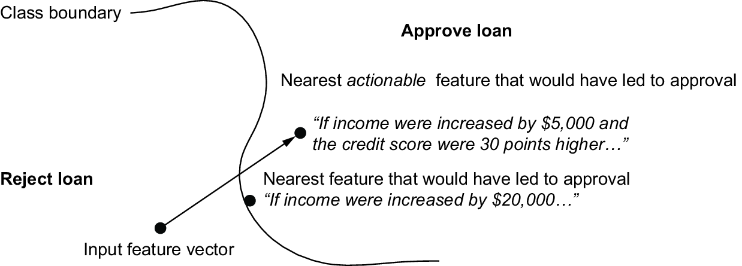
The figure visualizes recourse as the nearest actionable feature vector across the model’s decision boundary. section 8.1.3
